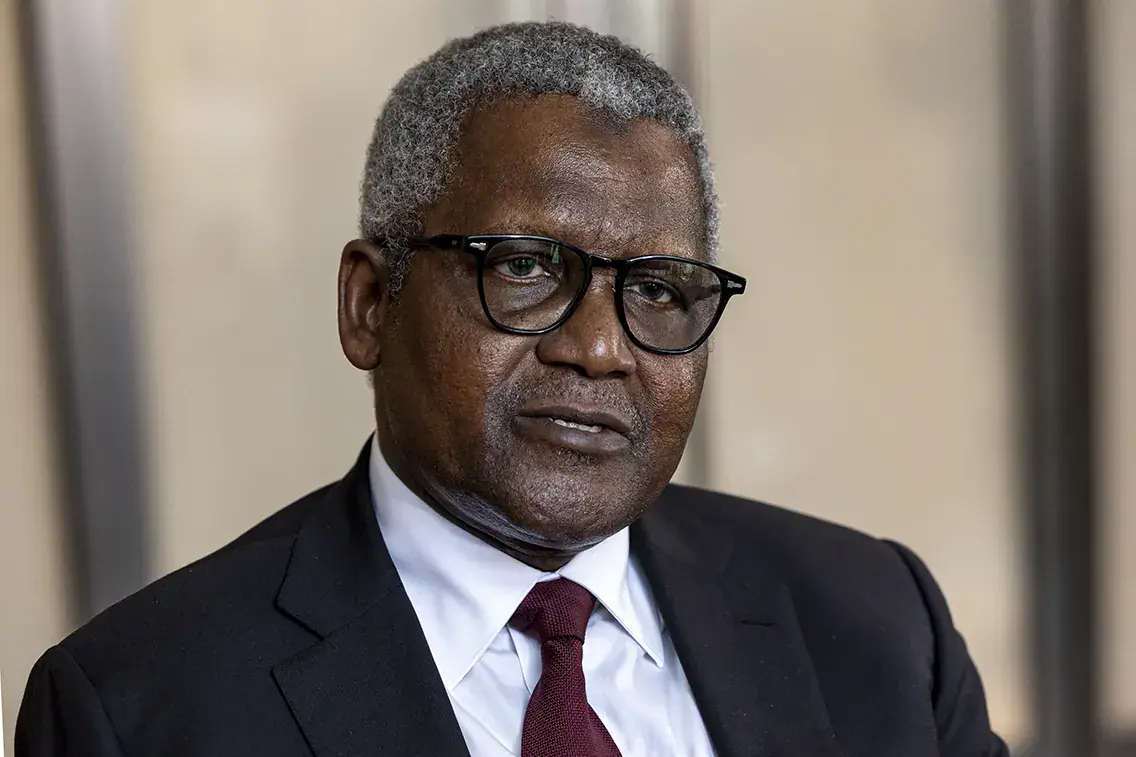
In a groundbreaking move, Aliko Dangote's Initial Public Offering (IPO) for his Nigerian refinery has opened up investment opportunities to Africans across the continent. The IPO, which values the refinery at $49 billion, is being marketed through a patchwork of depositary receipts, allowing investors in countries such as Kenya, Botswana, Uganda, Rwanda, Ethiopia, and Egypt to participate. This development marks a significant shift in intra-African investment, as ownership of a Nigerian industrial asset can now be held without the need for a Lagos brokerage account or international travel.
The Dangote IPO, which opened on the Nigerian Exchange on September 14 and closed on October 27 after a two-week extension, has generated significant interest among African investors. The offer was priced at ₦525 per share for roughly 3.3% of the company, with the refinery's revenue for the first nine months of 2026 reported at $22.5 billion and profit after tax at $4.7 billion. With $6.7 billion in cash, the IPO has already received subscriptions amounting to more than three or four times the original target, according to Dangote.
The concept of a pan-African IPO was unthinkable a few years ago due to the continent's fragmented financial architecture. African capital markets have traditionally been disconnected, with each country's securities regulator governing only its own territory. The African Continental Free Trade Area (AfCFTA) has created a framework for trading goods across 54 markets, but it lacks an equivalent for jointly regulating share sales. To overcome this hurdle, Dangote's team used depositary receipts, an old instrument in a new direction, to facilitate the IPO.
The use of depositary receipts has enabled African companies to invest in the Dangote refinery without navigating complex regulatory requirements. A local custodian holds the Nigerian shares, while investors at home buy a receipt representing them in their own currency on their own exchange. Kenya's Nairobi bourse has taken the lead in this initiative, with Renaissance Capital planning to follow the template used for the Kenya Pipeline Company IPO. This development could pave the way for more intra-African investment and cooperation among African bourses.
The Dangote IPO has sparked interest in various African countries, with almost 51 of Africa's 54 countries reportedly taking part in some form, according to United Capital's chief executive, Peter Ashade. The initiative has also fostered cooperation among regional exchanges, with Angola reportedly also in the running to host the listing. This kind of cooperation has been discussed at conferences for twenty years, but the Dangote IPO has brought it to fruition.
For Dangote, the primary objective of the IPO is wealth distribution rather than capital accumulation, as he has already secured adequate financing for his operations. The billionaire entrepreneur sees this initiative as a way to open up the market and make Africa more attractive to investors. A shareholder base spread across a dozen African countries is also a political asset for a company that has faced regulatory challenges and opposition from fuel importers and its national oil company.
The success of the Dangote IPO could have far-reaching implications for intra-African investment and the continent's economic integration. As investors from across Africa participate in the offering, it may pave the way for more cross-border investments and cooperation among African companies. With the potential for more Africans to own a slice of a Nigerian industrial asset, the Dangote IPO is revolutionizing the way investments are made across the continent.
Key points
- The Dangote IPO has generated significant interest among African investors, with subscriptions amounting to more than three or four times the original target.
- The use of depositary receipts has enabled African companies to invest in the Dangote refinery without navigating complex regulatory requirements.
- The initiative has fostered cooperation among regional exchanges, with almost 51 of Africa's 54 countries reportedly taking part in some form.