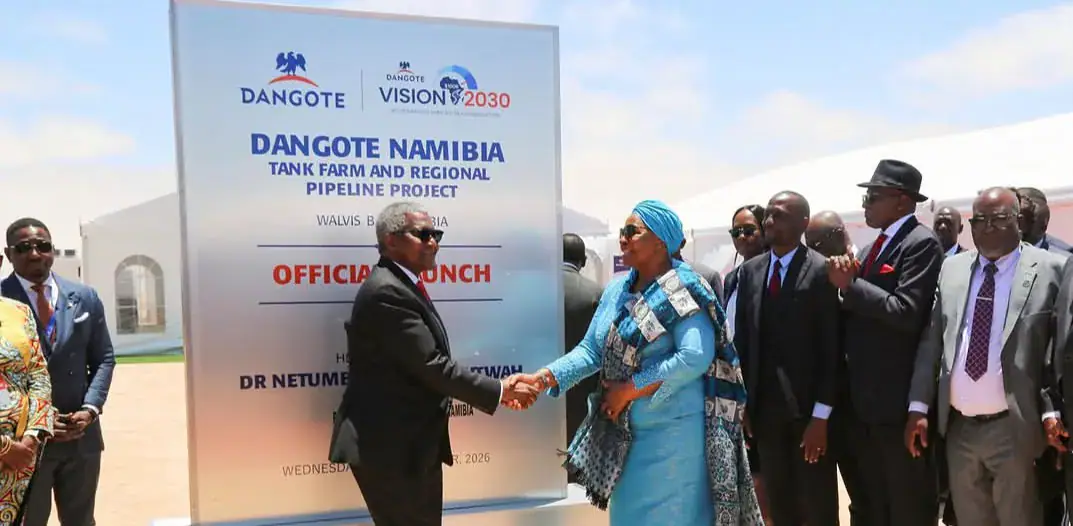
Nigerian industrialist Aliko Dangote has launched a $2.5 billion fuel storage and regional pipeline project in Namibia. The project aims to strengthen petroleum distribution and expand trade links across Southern Africa. The launch ceremony took place on November 4 at Farm 58 near the coastal town of Walvis Bay. Namibian President Netumbo Nandi-Ndaitwah joined Dangote, chairman and chief executive of Dangote Group, at the event.
The project includes a petroleum storage facility with a planned capacity of 600 million liters, comprising 360 million liters of diesel and 240 million liters of petrol. A regional pipeline network extending approximately 1,700 kilometers inland from Walvis Bay towards markets in neighboring countries is also planned. The proposed network will connect Namibia with Botswana, Zambia, Zimbabwe, Malawi, and the southern Democratic Republic of Congo. The final route and length will depend on detailed engineering studies, route surveys, and regulatory approvals.
The investment is expected to position Walvis Bay as an important entry and distribution point for petroleum products serving countries across the region. This includes landlocked markets that depend on transport corridors to access imported fuel. For Namibia, the project could significantly expand existing fuel storage capacity. The planned 600-million-liter facility is approximately eight times the capacity of the country’s existing 75-million-liter National Oil Storage Facility.
According to Dangote, the infrastructure will help reduce shipping and distribution costs, while improving energy security and reducing logistical vulnerabilities. He also expects the development to support fuel supply beyond Namibia, creating a wider commercial network for petroleum products across Southern Africa. The project is part of Dangote Group’s broader expansion beyond Nigeria, where the company operates a major refinery with a capacity of about 700,000 barrels per day.
The Namibian government has attached significant importance to the investment. During the launch, Nandi-Ndaitwah said the project would remain under the direct oversight of her office until completion. This measure is intended to prevent administrative delays from slowing its implementation. The president emphasized that Namibia cannot afford to lose major investments due to bureaucratic obstacles, particularly as the country seeks to create jobs, reduce poverty, and expand its industrial capacity.
Beyond fuel storage and transportation, the development is expected to create opportunities for construction companies, local suppliers, logistics operators, and other businesses. The government has presented the project as an opportunity to strengthen skills development and increase local participation in major infrastructure investments. However, the launch marks the beginning of a major development rather than the start of operations. Dangote told Reuters that completion of the facility and associated infrastructure is expected to take approximately 18 to 20 months.
If delivered as planned, the project could change how petroleum products move through parts of Southern Africa. Walvis Bay would gain a larger role in supplying inland markets, while the proposed pipeline could offer an alternative to the long-distance road transportation currently used to move fuel across several countries. The scale of the investment also reflects growing competition to develop energy and transport infrastructure across Africa. For Dangote, the Namibian project provides an opportunity to extend the reach of his petroleum business into Southern Africa.
Key points
- The project includes a 600 million liter petroleum storage facility and a 1,700 kilometer regional pipeline network.
- The investment is expected to position Walvis Bay as a major entry point for petroleum products in Southern Africa.
- The project is expected to be completed in 18 to 20 months.