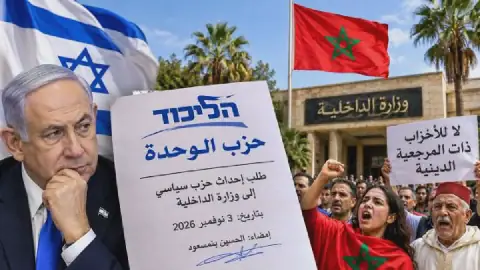
A request to establish a Jewish party in Morocco, named after Israeli Prime Minister Benjamin Netanyahu's Likoud party, has sparked widespread controversy in the country. The application, submitted to the Moroccan Interior Ministry on November 3, 2026, is signed by El Hocine Benmessaoud, who claims to be acting on behalf of the party's constitutive coordination. The party's name, Al Wihda, translates to "unity" in Arabic, while "Likoud" is written in Hebrew characters at the top of the document.
The proposed party's founders cite Morocco's constitution, King Mohammed VI's title as "commander of all believers," and the country's recent normalization agreement with Israel as justification for the party's creation. However, critics argue that the party's name and ideology are at odds with Moroccan values and traditions. Ahmed Ouihman, head of the Moroccan Observatory Against Normalization, warned that using religious and cultural identities for political gain related to normalization could be detrimental.
The application has sparked heated debate on social media, with many Moroccans expressing concerns about the potential implications of a Jewish party in the country. Idriss El Kanbouri, a Moroccan researcher, questioned the use of the term "commander of believers," arguing that it refers to the protection of religious freedom and does not imply the transfer of Islamic institutions to other religions.
In response to the backlash, Moroccan authorities have issued a statement denying that the document constitutes a formal declaration of the party's creation. A source close to the government told Hespress that the document was merely a letter signed by one person and did not imply acceptance or have any legal consequences.
Despite the government's assurances, concerns remain about the potential for the party to be approved, particularly if it receives support from Israel. Morocco has recently taken steps to accommodate Israeli interests, including expelling Moroccan citizens from their homes and lands to make way for Jewish Moroccans who have returned to Israel.
The controversy surrounding the proposed Likoud party highlights the complexities and challenges of Morocco's normalization agreement with Israel. The agreement has sparked widespread debate and criticism in Morocco, with many questioning the country's shift in policy towards Israel and its implications for regional stability.
As the Moroccan government considers the application, it will need to balance the country's commitment to democratic principles and human rights with concerns about national identity and security. The outcome of the application is uncertain, but one thing is clear: the proposed Likoud party has ignited a contentious debate that will continue to unfold in the coming weeks and months.
Key points
- Moroccan authorities have denied that the document constitutes a formal declaration of the party's creation.