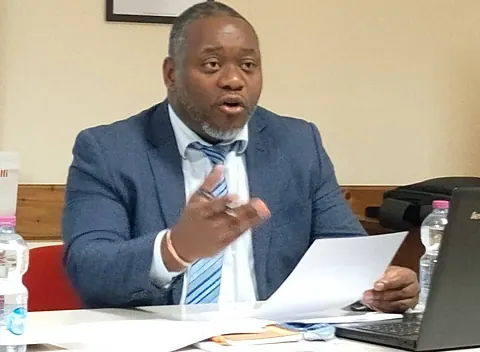
A Congolese doctoral student at the Pontifical Gregorian University in Rome, Patient Baderha, has urged for a constitutional debate in four national languages of the Democratic Republic of Congo. This would ensure citizens' participation in the country's reform process. Baderha emphasized that the Constitution recognizes national languages, making it essential for crucial information to be accessible in these languages. This way, every citizen can understand the issues at stake and contribute meaningfully to the national reflection.
According to Baderha, one of the main challenges in the institutional debate is making constitutional issues accessible to all Congolese, beyond political and academic circles. He suggested that educational materials, proposals, summaries, and explanations related to the constitutional debate should be disseminated not only in French but also in Kikongo, Lingala, Swahili, and Tshiluba. This would guarantee informed participation from all citizens. Baderha also advocated for a sectoral approach, considering the Constitution's impact on various aspects of national life.
The Constitution touches on multiple areas, including justice, diplomacy, economy, health, education, environment, and decentralization. Each sector requires input from its experts, Baderha stated. He proposed that constitutional experts, magistrates, economists, diplomats, public health specialists, researchers, academics, and public administration experts should be involved in the discussions. This should be alongside civil society organizations, women, youth, customary authorities, economic operators, and the diaspora.
Baderha emphasized that expertise provides insight, institutions deliberate, and the people participate, exercising their constitutional prerogatives. He suggested that Congolese universities and research centers should play a greater role in the process by producing analyses that inform public choices. By making science a tool for public debate, discussions can be enriched with data, studies, and comparative experiences, rather than solely political considerations.
Without taking a stance on revising or amending the Constitution, Baderha stressed the need for a method based on competence, pluralism, and citizen participation. He concluded that a sustainable Constitution should not only be understood by its drafters and interpreters but also explained to, discussed with, and understood by the people. This approach would contribute to strengthening national cohesion and rebuilding the state.
Baderha's proposal aims to promote inclusivity and citizen engagement in the constitutional debate. By making information accessible in multiple languages, more people can participate in the discussion. His suggestions also highlight the importance of sectoral expertise and the involvement of various stakeholders in the process.
The Congolese press agency reported on Baderha's plea for a multilingual constitutional debate. His statements were made in an interview with the agency. No official response has been reported from the Congolese government or other stakeholders regarding Baderha's proposals.
Key points
- A Congolese academic is advocating for a constitutional debate in four national languages to ensure citizen participation.
- The proposed languages for the debate are Kikongo, Lingala, Swahili, and Tshiluba.
- The academic, Patient Baderha, emphasizes the need for a sectoral approach and involvement of experts from various fields.