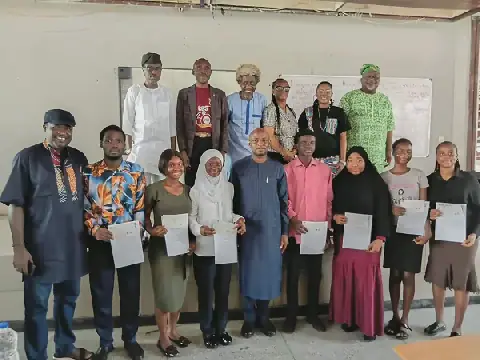
The Ministry of Health and Public Hygiene in Guinea organized a roundtable on October 28, 2026, in Conakry, to mobilize resources for the implementation of the Plan de passage à grande échelle (PAGE). This plan aims to integrate family planning, maternal, neonatal, and infant health services, as well as nutrition, into healthcare services. The ceremony, presided over by the Minister of Health, brought together ministry officials, technical and financial partners, and representatives from private institutions and foundations.
The PAGE plan, validated after a pilot phase in Coyah, requires over 13 billion Guinean francs in funding. The roundtable seeks to gather actors around a common financing framework and better coordinate actions to ensure the plan's implementation. According to Dr. Fatoumata Battouly Diallo, adviser to the Ministry of Health, the goal is to obtain concrete commitments to strengthen the integration of healthcare services in Guinea.
Dr. Jean Marie Kipela, representative of the World Health Organization (WHO) in Guinea, highlighted the country's alarming health statistics, including 501 maternal deaths per 100,000 live births and 31 newborn deaths per 1,000 within the first month. He reaffirmed the WHO's commitment to supporting the implementation of the PAGE plan through technical and strategic assistance.
Dr. Cheick Touré, regional director for Africa at Global Communities, expressed his organization's support for the Guinean government's efforts to improve maternal and child health. He emphasized the need for concrete, measurable commitments aligned with national priorities, and encouraged partners to work together to achieve tangible results.
The United Kingdom, a partner engaged in improving health outcomes in Guinea, pledged its support for the PAGE plan. Ambassador Daniel Shepherd advocated for a more integrated healthcare system, centered on the individual, to address challenges such as maternal mortality, access to contraception, and malnutrition.
The roundtable aims to secure funding commitments from partners and establish a roadmap for the PAGE plan's implementation. The Ministry of Health hopes to build on the success of the pilot phase in Coyah, where positive results were recorded. The plan's success will depend on the coordination and complementarity of actions from various stakeholders, including NGOs, associations, and other actors.
Key stakeholders, including the WHO, Global Communities, and the United Kingdom, have expressed their commitment to supporting Guinea's efforts to improve maternal and child health. The PAGE plan's implementation will be closely monitored, with a focus on achieving concrete results and improving the lives of women and children in Guinea.
Key points
- The PAGE plan requires over 13 billion Guinean francs in funding to implement integrated healthcare services.
- Guinea records 501 maternal deaths per 100,000 live births and 31 newborn deaths per 1,000 within the first month.
- The roundtable aims to secure concrete commitments from partners to support the implementation of the PAGE plan.