The United Kingdom is home to a diverse array of family structures, reflecting shifting social attitudes, legal reforms, and economic conditions. According to the Office for National Statistics, these structures include married-couple families, cohabiting-couple families, same-sex couple families, lone-parent families, reconstituted families, extended families, and adoptive and foster families. The traditional nuclear family, comprising a married couple with children, remains a primary structural foundation in the UK. This type of family often functions through a formal legal contract that provides specific financial, tax, and parental rights.
Cohabiting-couple families, consisting of unmarried opposite-sex couples living together with or without children, have become one of the fastest-growing family types in the UK. While they operate similarly to married families, sharing a household and raising children, they lack automatic legal protections and rights afforded to married couples. This often necessitates individual legal agreements to secure their family arrangement. In contrast, same-sex couple families have gained substantial legal recognition and social visibility since the legalization of same-sex marriage and civil partnerships on 17 July 2013, with the first same-sex marriages taking place on 29 March 2014.
Lone-parent families, headed by a single mother or father living with dependent or non-dependent children, make up a significant portion of UK households. These families often face economic pressures due to reliance on a single income, prompting many to rely heavily on external support networks, state benefits, or flexible working arrangements. Reconstituted families, or blended families, form when one or both partners bring children from a previous relationship into a new union, navigating complex emotional and logistical landscapes.
Extended families and multi-generational households, which include grandparents, aunts, uncles, or cousins under one roof or as part of a closely linked family network, have seen growth in the UK. This is largely influenced by cultural traditions in certain ethnic communities and economic pressures like high housing costs. These families operate on a system of reciprocal exchange, with grandparents frequently providing crucial daily childcare and financial contributions.
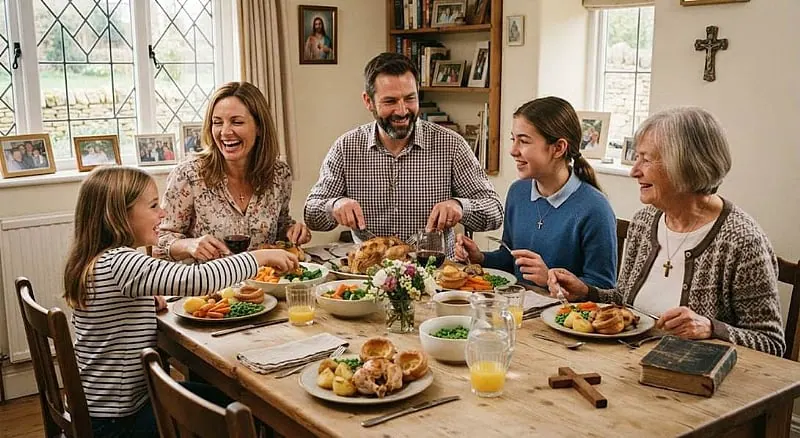
Adoptive and foster families, created through social care systems or legal procedures, provide safe environments for children who cannot live with their biological parents. Foster families operate on a temporary or transitional basis, working closely with local authorities and social workers, while adoptive families establish permanent, legally binding ties. British Christians perceive the family as more than a social arrangement, recognizing it as the principal place where human beings first experience love, belonging, responsibility, conflict, forgiveness, and sacrifice.
A Christian approach to family acknowledges the realities in which people live, rather than romanticizing the past. This approach recognizes that many families today face pressures such as the high cost of housing, financial uncertainty, and demanding employment. Christians in the UK are seeking to understand how their faith can inform their understanding of family and relationships in a rapidly changing society.
As the British family continues to evolve, Christianity's influence on marriage values remains significant. With an increasing number of people living alone or in non-traditional family arrangements, Christians are faced with the challenge of reinterpreting traditional values in a modern context. By engaging with the complexities of family life in the UK, Christians can work towards building stronger, more resilient communities that reflect their values of love, forgiveness, and sacrifice.
Key points
- Christianity plays a significant role in shaping UK marriage values.
- The UK is home to a diverse array of family structures.
- Christians in the UK are seeking to understand how their faith can inform their understanding of family and relationships in a rapidly changing society.