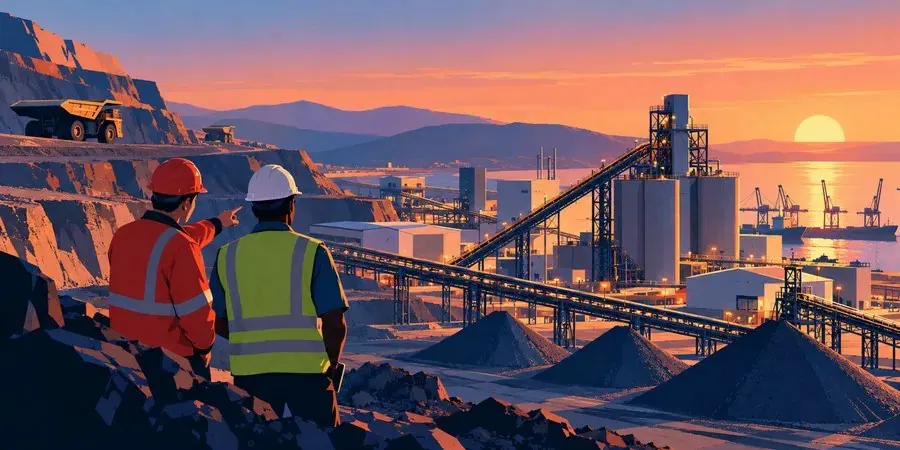
China and Africa are redefining their mining cooperation, moving beyond raw material extraction to focus on processing, industrial capacity, and shared value creation. Africa is rich in critical minerals such as copper, cobalt, lithium, graphite, and rare earth elements, essential for electric vehicles, batteries, and renewable energy systems. However, most of the continent's output is still exported as unprocessed ore. China's involvement brings much-needed capital, equipment, and expertise across mineral value chains, offering African producers a viable path to refining and domestic manufacturing.
Investors evaluating opportunities in Africa consider factors beyond the quality of resources. They assess power supply, transport links, policy stability, and the reliability of local partners. The development of mining infrastructure can have far-reaching economic benefits when integrated into national development plans. Infrastructure such as roads, railways, ports, and power grids not only connects producers to markets but also supports other industries along the way. A notable example is the Simandou iron ore project in Guinea, which includes a deepwater port and a 600-kilometer railway corridor linking mining areas to the coast.
Countries like Zambia and the Democratic Republic of Congo are prominent producers of copper and cobalt, while Zimbabwe has significant lithium resources. Expanding processing capacity in these countries can create skilled employment opportunities, develop local suppliers, and accelerate technology transfer. Chinese companies are also at the forefront of advancing green mining technologies, showcasing intelligent mining equipment, digital monitoring systems, and energy-efficient mineral processing solutions at the 2026 China International Mining Conference in Tianjin.
The conference, which opened on September 10, highlights China's commitment to sustainable mining practices. Exhibitors demonstrated cutting-edge technologies that can improve recovery rates and reduce operational costs at remote sites. Kenya's participation in the conference signals the country's growing ambition in the mining sector. Mining Cabinet Secretary Hassan Joho presented investment opportunities in various minerals and outlined governance reforms aimed at improving transparency and predictability for investors.
For African governments, the priority is to negotiate partnerships that retain more value within their countries. This involves linking mining licenses to processing commitments, local procurement targets, and skills development benchmarks. Chinese companies see an opportunity to build industrial platforms with African partners and develop regional markets. Environmental performance is now a critical component of the commercial equation, with water recycling, land rehabilitation, and on-site renewable power reducing operating risks and widening access.
Skills transfer is a crucial aspect of capital investment, enabling the creation of lasting local capability. African engineers, geologists, and environmental specialists require direct access to project experience and technical systems to develop their expertise. Without this, technology adoption may not be sustainable. The cooperation between China and Africa in the mining sector has the potential to drive economic growth, create jobs, and promote sustainable development.
As the mining sector continues to evolve, African governments and Chinese companies are working together to create mutually beneficial partnerships. By prioritizing skills development, environmental sustainability, and local value creation, these partnerships can contribute to the continent's economic growth and industrialization. The China-Africa mining cooperation is a significant step towards achieving these goals, with far-reaching implications for the future of the mining sector.
Key points
- China-Africa mining cooperation is shifting focus from raw extraction to processing and industrial capacity building.
- African governments prioritize negotiating partnerships that retain more value within their countries.
- Skills transfer and environmental sustainability are critical components of the China-Africa mining cooperation.