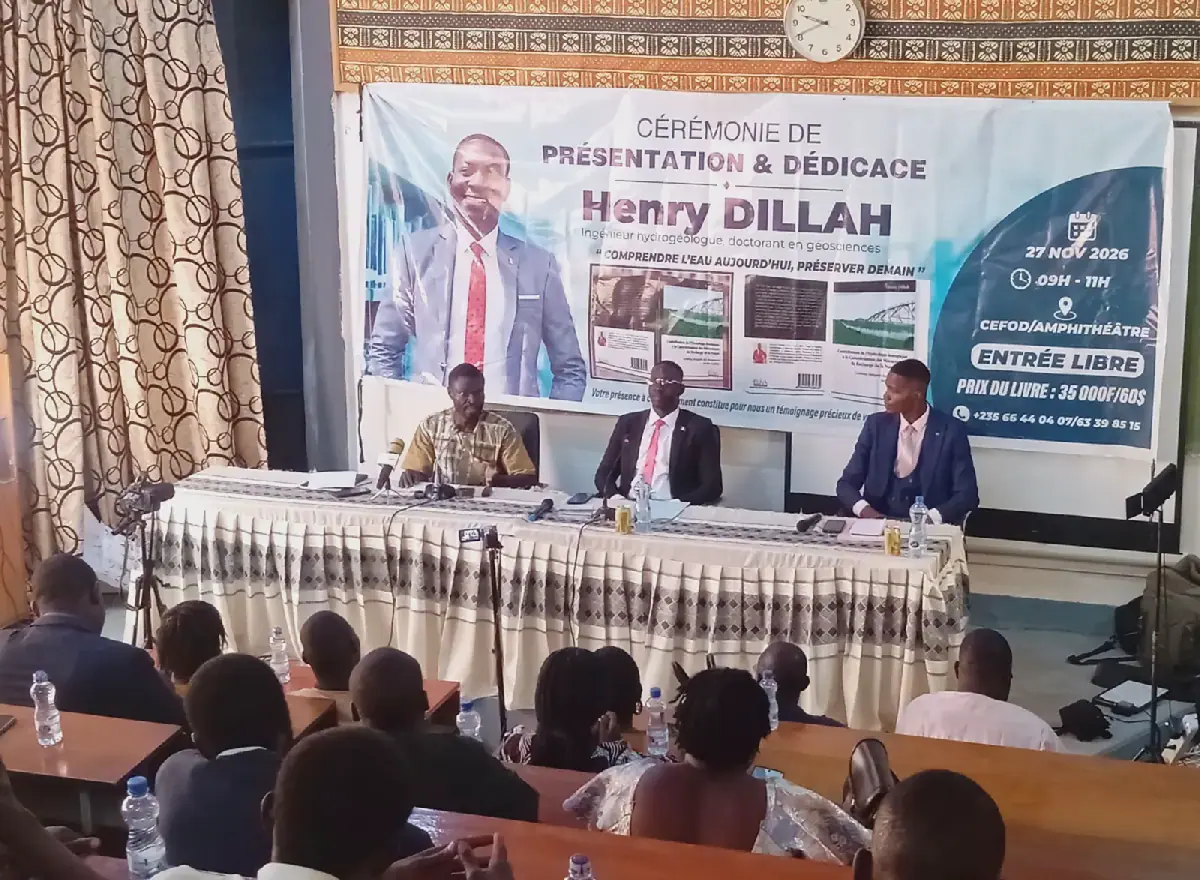
Chad's hydrogeologist Henry Dillah has presented his book, "Contribution of Isotopic Hydrology to the Characterization of Recharge Mechanisms of the Water Table: GIRE". The 134-page scientific publication aims to contribute to a better understanding of groundwater resources and their sustainable management. Dillah's work focuses on the importance of understanding groundwater recharge mechanisms to prevent depletion and ensure sustainable exploitation. His research highlights the precarious situation of the water table in Bongor.
The book's presentation ceremony, held in N'Djamena on November 27, 2026, brought together experts and stakeholders to discuss the challenges of managing water resources in Chad. The event's theme, "Understanding Water Today, Preserving Tomorrow," underscored the need for sustainable water management practices. Dillah's research uses isotopic hydrology to analyze the origins of water and understand the interactions between surface and groundwater. His study examines the cases of Bongor's A and B areas, where agricultural activities and surface-water interactions affect groundwater recharge.
Dillah's research relies on the analysis of two stable isotopes of water: deuterium and oxygen 18. These natural markers help determine the origin of water, understand evaporation phenomena, and identify aquifer recharge mechanisms. The study explores three essential processes: groundwater recharge, mixing of different water masses, and evaporation. The book provides a scientific contribution to water management, emphasizing the need for integrated water resource management.
Literary critic Mbernodji Sosthène praises the book's scientific and territorial relevance, particularly in the context of Bongor's agricultural activities and surface-water interactions. Sosthène notes that the book's value lies not only in its hydrological analysis but also in its connection to integrated water resource management. The critic highlights the importance of understanding groundwater recharge conditions before defining strategies for its utilization.
During the ceremony, Dillah emphasized that his book is the result of years of research, field observations, and scientific analysis. He stressed that knowledge of water is essential for its preservation, stating, "We cannot manage sustainably what we do not know well, and we cannot protect effectively what we do not understand." Dillah called for increased investment in scientific research, laboratories, and hydrological monitoring systems.
Regarding the state of the water table in Bongor, Dillah expressed concern, citing the area's dependence on precipitation for recharge. He warned that periods of drought or decreased water supply can reduce recharge, while increased pumping exacerbates pressure on the resource. Dillah recommends regular monitoring of groundwater levels and better management of withdrawals to prevent depletion.
Dillah highlights the value of isotopic hydrology in understanding groundwater resources, allowing for better identification of water origins and interactions between hydrological reservoirs. He proposes an integrated water resource management scheme applicable at national, sub-regional, and international levels, advocating for a concerted approach involving public institutions, researchers, and users.
Key points
- Hydrogeologist Henry Dillah presents a book on groundwater management and sustainability in Chad.
- The book highlights the precarious situation of the water table in Bongor and proposes an integrated water resource management scheme.
- Dillah emphasizes the need for increased investment in scientific research and hydrological monitoring systems.