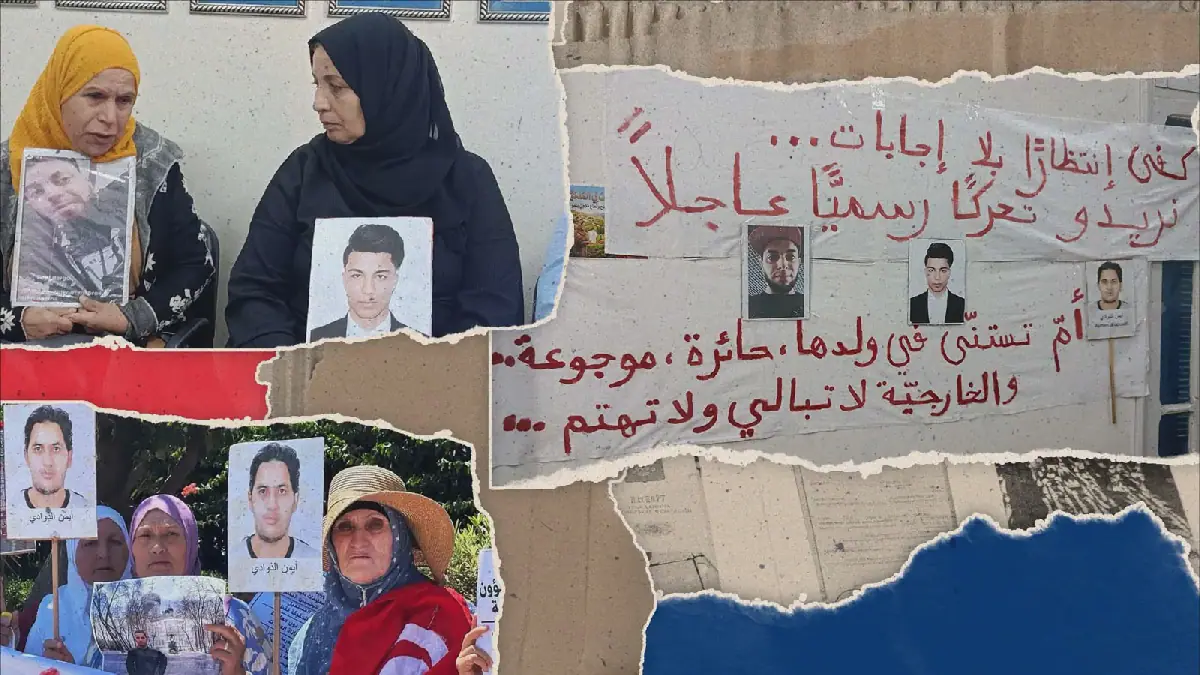
The families of Tunisians who have joined the Russian army or gone missing in Russia are facing an uncertain and frustrating wait for information on their loved ones. Despite repeated appeals and gatherings in front of the Tunisian Ministry of Foreign Affairs, the families lament the lack of official clarification on the fate of their relatives. New cases continue to emerge, revealing that Tunisians are still joining the Russian army.
Fatouma Methlouthi, a mother from Tunisia, shared her story with Inkyfada. Her son, Fadi Barguellil, left Tunisia in 2012 and settled in Russia, where he married a Russian woman and had a daughter. He obtained Russian citizenship in 2013 but was prevented from leaving the country due to his military status. In 2025, Fadi attempted to return to Tunisia but was arrested and imprisoned. His mother claims he was given an ultimatum: face a 20-year prison sentence, lose his citizenship and custody of his daughter, or sign a one-year contract with the Russian army.
Fadi was reportedly injured in combat and transferred to a hospital in Rostov. His family received a death certificate from his wife, but they were unable to verify the circumstances of his death or obtain official information on his fate. The Association for the Rescue of Tunisians Stranded Abroad has documented around 12 cases of Tunisians who have joined the Russian army under duress or gone missing. The association's president, Mohamed Iqbel Ben Rejeb, stated that the Tunisian authorities have not responded to the families' pleas.
Another case involves Ahmed Tlili, a 24-year-old from Sakiet Sidi Youssef. His brother, Hammadi, reported that Ahmed disappeared on February 22, 2026, and later called to say he had signed a one-year contract with the Russian army. However, the family has not received any information on his whereabouts or fate since their last conversation on March 24, 2026. Hammadi stated that their mother's health has deteriorated due to the uncertainty surrounding Ahmed's disappearance.
The families of the missing Tunisians have not only sought help from intermediaries and lawyers in Russia but have also turned to the Tunisian authorities. They have submitted requests, letters, and visited the Ministry of Foreign Affairs, but have not received clear responses on the fate of their loved ones. A mother, who wished to remain anonymous, shared her experience of being assured by the ministry that Tunisians would not be recruited, only to discover that her son had been enrolled and his passport confiscated.
The lack of coordination between Tunisian and Russian institutions has hindered efforts to verify the cases of disappearance and death. The Association for the Rescue of Tunisians Stranded Abroad has criticized the Tunisian government's inaction in addressing the issue. Mohamed Iqbel Ben Rejeb confirmed that the state has not reacted to the families' pleas, despite their gatherings in front of the Ministry of Foreign Affairs.
Inkyfada's investigation, "From University to the Front: How Tunisians End Up in the Russian Army," revealed a lack of response from the Tunisian authorities. The association and families of the missing Tunisians continue to seek answers and push for action from the government to address the situation.
Key points
- The Tunisian government has not provided clear information on the fate of its citizens who have joined the Russian army or gone missing in Russia.
- Families of the missing Tunisians have faced frustration and uncertainty in their attempts to seek help from the authorities.
- The lack of coordination between Tunisian and Russian institutions has hindered efforts to verify the cases of disappearance and death.