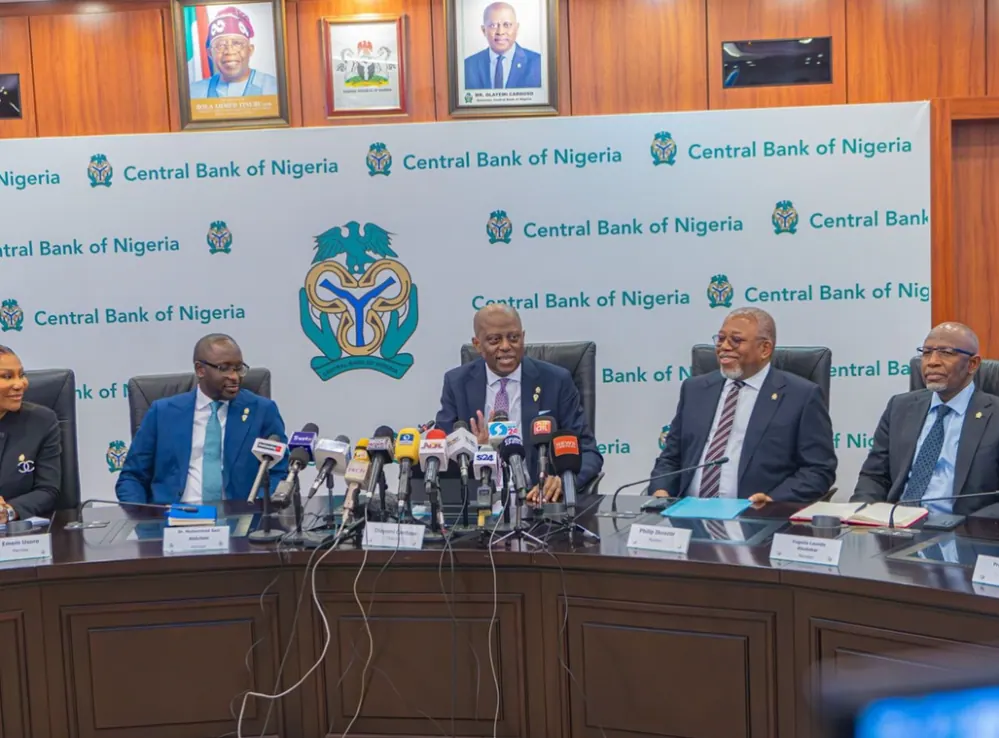
The Central Bank of Nigeria (CBN) has announced a significant reduction in the nation's underlying interest rate benchmark, cutting the Monetary Policy Rate (MPR) from 26.50% to 23.00%. This 350 basis point cut was decided at the 307th policy meeting of the 11-member Monetary Policy Committee (MPC) in Abuja. The committee, headed by CBN Governor Olayemi Cardoso, aims to make the monetary policy framework more effective and align it with the country's stable macroeconomic fundamentals.
The MPC also adjusted the Standing Facilities Corridor around the MPR from +50 and -450 basis points to +50 and -300 basis points, while keeping other parameters unchanged. The Cash Reserve Requirement (CRR) remains at 45% for deposit money banks, 16% for merchant banks, and 75% for non-Treasury Single Account (TSA) public-sector deposits. Additionally, the liquidity ratio stayed unchanged at 30.0%. These decisions are expected to provide sufficient support for financial system stability while encouraging bank lending.
According to CBN Governor Olayemi Cardoso, the decision to cut the interest rate was made possible by Nigeria's improved economic fundamentals, which have moved from a period of significant volatility to one of stability. This stability allows businesses and investors to plan with greater certainty. Cardoso emphasized that the adjustment is not a change in the underlying monetary policy stance but rather an operational realignment to strengthen transmission and support Nigeria's transition towards an inflation-targeting system.
The CBN governor explained that the relationship between the MPR and prevailing market interest rates had weakened, necessitating the adjustment to close the gap between the benchmark rate and the rates at which banks lend and borrow in the money market. Cardoso noted that the MPR had not been effectively transmitted through the financial system, and the apex bank aims to ensure that it again becomes the main signal for monetary policy.
The Nigerian equities market responded positively to the CBN's adjustment, with the All-Share Index (ASI) rising by 18 basis points to 250,614.66 points and aggregate market capitalization of quoted equities increasing by N298 billion to close at N162.683 trillion. Experts described the interest rate cut as a significant reset for the economy, commending the apex bank for transitioning Nigeria's macroeconomic stability into greater support for the productive sector and consumers.
Economists and analysts have welcomed the MPC's decision, citing moderating inflation, exchange rate stability, improvement in foreign exchange market liquidity, and accretion to external reserves as justification for the rate cut. They expect the reduction to help reduce financing pressures on businesses, strengthen investment prospects, support economic growth, and progressively moderate the government's domestic debt-service burden.
The MPC's decision came against the backdrop of further moderation in inflation and stronger economic activity. Headline inflation fell marginally to 15.39% in August from 15.43% in July, while food inflation declined from 20.31% to 19.57%, and core inflation dropped from 14.97% to 13.29%. On a month-on-month basis, headline inflation slowed considerably from 1.57% in July to 0.71%.
Key points
- The CBN reduced the Monetary Policy Rate (MPR) by 350 basis points from 26.50% to 23.00%.
- The interest rate cut aims to make monetary policy more effective and align with Nigeria's stable macroeconomic fundamentals.
- The decision is expected to support economic growth, reduce financing pressures on businesses, and moderate the government's domestic debt-service burden.