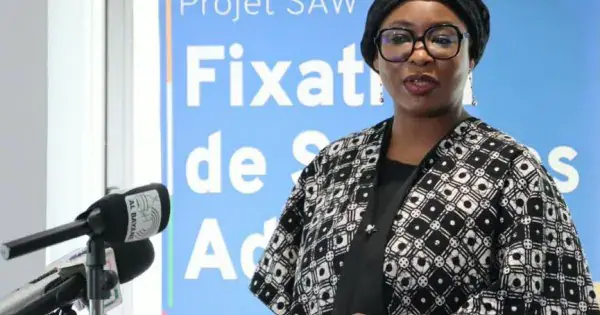
The International Labor Organization (ILO) has concluded its "Setting Adequate Wages" (SAW) project in Côte d'Ivoire, which aimed to promote decent remuneration for workers. After three years of implementation, the project has contributed to the strengthening of social dialogue and improvement of wage-setting mechanisms. The project's closure ceremony was held on November 6, 2026, in Abidjan, where stakeholders discussed the project's achievements and future prospects.
The SAW project, funded by the Kingdom of the Netherlands, focused on developing the skills of national actors and promoting better consideration of economic and sectoral realities in wage discussions. A total of 343 people, including 41% women, benefited from training sessions organized under the project. Six social dialogue frameworks were also supported, and five studies and tools were developed for various economic sectors, including cocoa, banana, cashew, and agriculture.
Coumba Diop, director of the ILO office covering Côte d'Ivoire, Benin, Burkina Faso, Mali, Niger, and Togo, highlighted the project's significant achievements. She emphasized that decent remuneration is essential for improving workers' living conditions and that the project's success will depend on the ability of national actors to sustain the initiatives after its closure. Diop also stressed that work should not only provide a means of survival but also enable workers to live with dignity.
The project's impact was also acknowledged by Yao N'Dri, representing the FESACI CG workers' union. He noted that the issue of wages is closely linked to purchasing power and household protection. N'Dri recalled the 25% increase in the minimum interprofessional guaranteed salary (SMIG) in January 2023, which rose from 60,000 to 75,000 FCFA. However, he emphasized that efforts should go beyond the increase in the minimum wage and advocated for Côte d'Ivoire's full integration into the ILO's global program on vital wages.
Léopold Bodo, representing the Confédération générale des entreprises de Côte d'Ivoire (CGECI), defended an approach that balances workers' legitimate aspirations with the economic capacities of enterprises. He argued that a comprehensive reflection on adequate wages must consider factors such as productivity, economic performance, competitiveness, and the business environment. Bodo emphasized the importance of tripartite dialogue in finding balanced solutions that meet social justice requirements without jeopardizing the economic fabric.
The closure ceremony also marked the launch of new initiatives aimed at sustaining the project's achievements. The ILO's global program on vital wages and the SAW-A project are presented as essential levers for prolonging the dynamic. The ILO and its partners aim to promote remuneration that allows workers and their families to meet their essential needs and live decently. Stakeholders emphasized the need for continued technical assistance, capacity building for trade unions, and the sustainability of social dialogue mechanisms.
As the SAW project comes to a close, the ILO and the government of Côte d'Ivoire are committed to continuing their collaboration to promote decent work and social justice. The project's achievements and challenges will inform future initiatives aimed at improving working conditions and promoting sustainable development in Côte d'Ivoire.
Key points
- The ILO's project has contributed to the strengthening of social dialogue and improvement of wage-setting mechanisms in Côte d'Ivoire.