The Observatoire de la fluidité des transports (OFT) in Côte d'Ivoire aims to strengthen its action on the San Pedro-Bamako corridor by focusing on proximity with local populations and promoting a culture of complaint. This approach was presented during the restitution of the four-year activity report of the OFT, within the framework of the Road Development and Transport Facilitation Project on the Bamako-Zantiébougou-Boundiali-San Pedro corridor (PR8).
The OFT's intervention is based on monitoring four indicators: the number of roadblocks per 100 kilometers, the dwell time of goods at the autonomous port of San Pedro, the crossing time of the corridor, and the border crossing time between Côte d'Ivoire and Mali. To enhance its presence on the ground, the OFT will rely on local transport facilitation committees (CLFT), placed under the authority of prefects, to diagnose obstacles to circulation and take initiatives to dismantle illegal roadblocks.
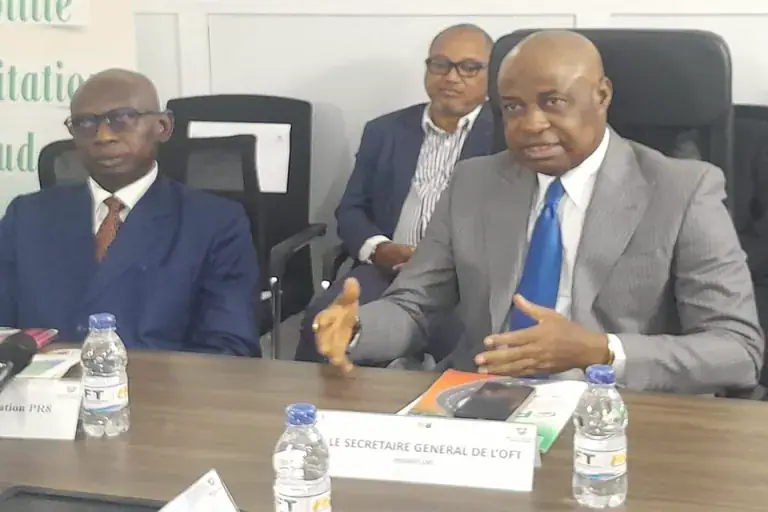
The CLFT, in collaboration with defense and security forces, will work to identify and eliminate illegal roadblocks, even in the absence of OFT teams. This approach will be accompanied by sensitization of populations to the complaint culture and strengthening partnerships with the military tribunal. Dr. Kouyaté Mohamed, Secretary General of the OFT, emphasized that fluidity is a major issue for economy, mobility, and development, and that it requires a collective effort.
Since 2021, the OFT has recorded significant results, including a reduction in the average crossing time of the corridor from 72 to 48 hours, and even 44 hours without considering rest times. The dwell time of goods at the autonomous port of San Pedro has been reduced from over two weeks to around seven days. However, the fight against roadblocks remains a challenge, with an average of five roadblocks per 100 kilometers, up from 2.8, while the norm is three.
The Road Development and Transport Facilitation Project on the Bamako-Zantiébougou-Boundiali-San Pedro corridor (PR8) is a joint initiative of Côte d'Ivoire and Mali, supported by technical and financial partners, including the African Development Bank (BAD) and the West African Economic and Monetary Union (UEMOA). Approved in November 2015, the project aims to improve the road connection between Bamako and the port of San Pedro, reduce transport costs and times, and facilitate commercial exchanges between the two countries.
The PR8 project has enabled the paving of around 275 km of roads, including 140 km between Zantiébougou and the Ivorian border in Mali, and 135 km between Boundiali and Kani in Côte d'Ivoire. The project also includes connected developments for the benefit of local populations and actions to facilitate transport and trans-border transit. Beyond the development of the areas crossed, the PR8 aims to strengthen economic integration between the two countries and consolidate the role of the port of San Pedro in serving the hinterland countries.
The OFT's Secretary General, Dr. Kouyaté Mohamed, expressed his wish that the OFT's achievements be improved, and that with the support of various stakeholders, the ambition to make this corridor a reference for development routes in the ECOWAS region can be achieved. The project's initial cost is estimated at around 138.6 billion FCFA.
Key points
- The OFT's new approach focuses on proximity with local populations and promoting a culture of complaint to identify and combat obstacles to circulation on the San Pedro-Bamako corridor.
- The project has achieved significant results, including reduced crossing and dwell times, but still faces challenges in eliminating roadblocks.
- The PR8 project aims to strengthen economic integration between Côte d'Ivoire and Mali and consolidate the role of the port of San Pedro in serving the hinterland countries.