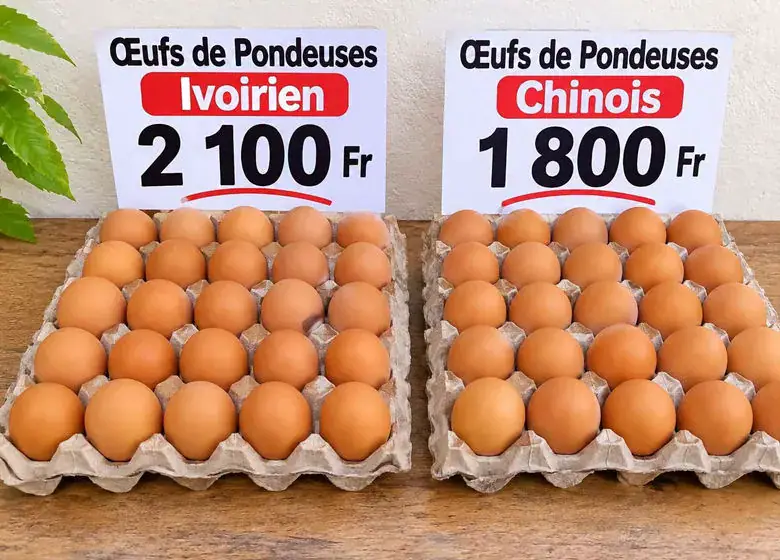
A heated debate is unfolding in Côte d'Ivoire over the presence of Chinese businesses, particularly in the sale of table eggs. Local entrepreneurs are voicing their concerns about the competition from Chinese operators, who are offering lower prices for the same products. For instance, Ivorian sellers are pricing a tray of 30 eggs between 2100 F and 2300 F CFA, while their Chinese counterparts are selling at 1800 F CFA.
Antoine Assalé Tiémoko, a former investigative journalist and prominent politician, has joined the fray, arguing that the Chinese invasion of the local market is not surprising given that China is the world's largest egg producer, with nearly 600 billion units produced annually. He notes that Chinese eggs are being sold in Abidjan's supermarkets for between 1300 and 1500 FCFA, allowing for a significant profit margin even at the lower price point of 1800 FCFA.
The issue goes beyond just eggs, with Chinese businesses expanding into various sectors in Côte d'Ivoire, including rice cultivation, automotive, beauty and wellness, poultry farming, construction, and telecommunications. Local entrepreneurs like Stéphane Sucré, a young rice farmer and economic operator, feel that the Chinese presence is stifling their businesses, making it difficult for them to compete.
While some Ivorian consumers are supporting local businesses, others are welcoming the competition from Chinese entrepreneurs. Some argue that local businesses are overpricing their products and that the Chinese are offering a more affordable alternative. Don Romarick Ehoulan, a consumer, believes that Ivorian businesses are often guilty of price gouging and that the Chinese are simply taking advantage of the market.
The debate has sparked a wider conversation about the role of foreign businesses in Côte d'Ivoire's economy and the need for protectionism. Some, like Jean Louis Acka, are calling for a boycott of Chinese products, arguing that the Chinese are using predatory pricing tactics to drive local businesses out of operation. Others, like Jonathan Morisson, a young entrepreneur, believe that Côte d'Ivoire should focus on developing its own economy rather than getting bogged down in a price war with Chinese businesses.
The controversy highlights the challenges faced by local businesses in Côte d'Ivoire, where the economy is largely liberal and open to foreign investment. While some argue that the Chinese presence is a threat to local businesses, others see it as an opportunity for growth and development. As the debate rages on, one thing is clear: the competition from Chinese businesses is forcing Ivorian entrepreneurs to rethink their strategies and adapt to a changing market.
Ultimately, the outcome of this competition will depend on how the Ivorian government responds to the concerns of local businesses and consumers. Will it take steps to protect local industries, or will it continue to promote a liberal economic policy that welcomes foreign investment? Only time will tell, but one thing is certain: the future of Côte d'Ivoire's economy hangs in the balance.
Key points
- Local entrepreneurs in Côte d'Ivoire are protesting against Chinese businesses offering lower prices for table eggs and other products.
- The Chinese presence in Côte d'Ivoire's economy is expanding into various sectors, including rice cultivation, automotive, and telecommunications.
- The debate has sparked a wider conversation about the role of foreign businesses in Côte d'Ivoire's economy and the need for protectionism.