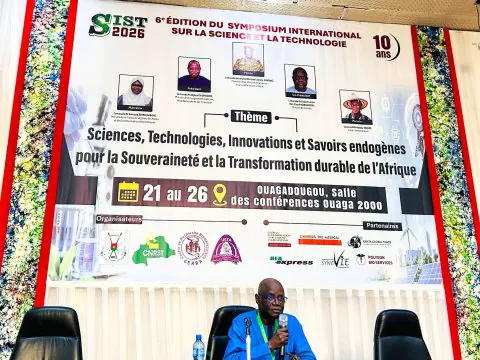
The 6th edition of the Symposium International sur la Science et la Technologie (SIST) was recently held in Burkina Faso, bringing together experts to discuss the role of artificial intelligence in scientific research. The conference was inaugurated with a presentation by Pr Jacques Simporé, a geneticist and bioethicist, and Pr Giuseppe Novelli, a professor of medical genetics at the University of Rome Tor Vergata. The symposium aimed to address the challenges and opportunities presented by artificial intelligence in the scientific community.
According to Pr Simporé, artificial intelligence is no longer just a tool for researchers but has become an "agent cognitif" capable of formulating hypotheses, exploring chemical spaces, predicting molecular structures, and assisting in the writing of scientific papers. This evolution is changing not only research methods but also the relationships between researchers, universities, research centers, governments, and companies. The question of whether artificial intelligence can become an instrument of scientific sovereignty and sustainable transformation for Africa is a pressing concern.
The use of artificial intelligence in research has led to significant breakthroughs in various fields. For instance, AlphaFold, developed by Google DeepMind, has revolutionized the field of biology by predicting the three-dimensional structure of proteins from their amino acid sequence. This has led to the creation of over 200 million structures, covering a substantial part of the known proteome. The work associated with AlphaFold has been recognized with the Nobel Prize in Chemistry in 2024.
In the field of genetics, artificial intelligence has enabled the analysis of the human genome at an unprecedented speed. Pr Giuseppe Novelli cited an example of a human genome that was previously analyzed by multiple people and laboratories over a long period, but can now be processed by artificial intelligence tools in a significantly reduced time. The medical applications of this acceleration are particularly noteworthy, with the potential to improve diagnosis and treatment.
However, Pr Novelli emphasized that artificial intelligence cannot replace doctors. The interpretation of genetic data requires a human touch, taking into account environmental factors, age, and other genetic and epigenetic modifications that can influence the expression of a disease. The use of artificial intelligence in medicine must be accompanied by a thorough understanding of its limitations and potential biases.
The sharing of data and observations between researchers and countries is crucial in addressing the challenges posed by artificial intelligence. Pr Novelli highlighted the importance of collaboration with patients from Africa, such as those in Burkina Faso and Ghana, to identify mutations specific to certain populations. This is particularly important in Africa, where the use of artificial intelligence must be adapted to local contexts and data.
The SIST symposium highlighted the need for Africa to develop its own capacity for scientific research and innovation, using artificial intelligence as a tool for sustainable development. The experts emphasized the importance of addressing the challenges of data sovereignty, ethics, and bioethics in the use of artificial intelligence in Africa.
Key points
- The use of artificial intelligence in research has the potential to accelerate scientific discovery and improve diagnosis and treatment in Africa.
- However, the use of artificial intelligence must be accompanied by a thorough understanding of its limitations and potential biases.
- The sharing of data and observations between researchers and countries is crucial in addressing the challenges posed by artificial intelligence.