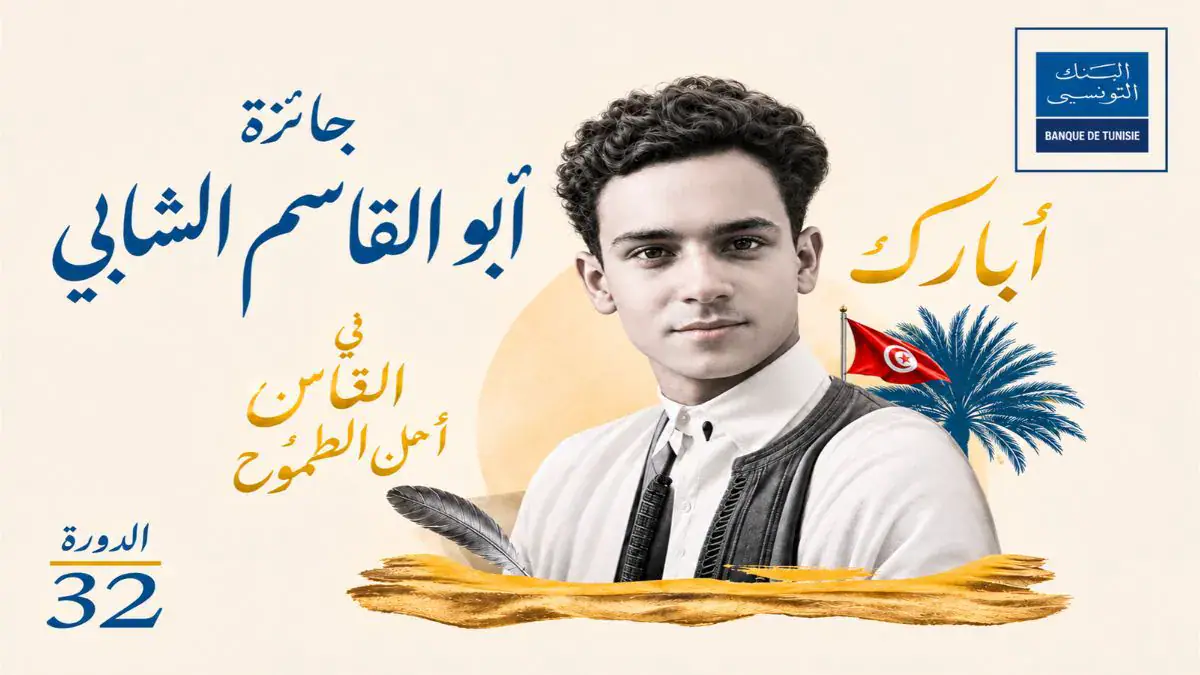
The 32nd edition of the Abou El Kacem Chebbi Literary Prize was held on November 21, 2026, at the grand hall of Ksar Saïd au Bardo. The event was marked by a symbolic gesture, where guests were welcomed with a bouquet of rosemary, a plant representing memory, fidelity, and roots. This year's theme was "Abou El Kacem Chebbi, Poet of Childhood," highlighting a vital aspect of his poetic universe. The ceremony was organized by the Banque de Tunisie, an institution that has been committed to promoting cultural engagement for nearly 40 years.
The choice of rosemary was not coincidental, as it has been a part of transmission and remembrance rituals for centuries. The plant's persistent fragrance defies time, much like the verses of Abou El Kacem Chebbi that continue to inhabit the collective Tunisian consciousness. By offering bouquets of rosemary, the Banque de Tunisie aimed to transmit a part of this living heritage, emphasizing that cultural memory requires maintenance, protection, and renewal across generations.
The ceremony featured artistic interludes by a young choir from Menzah 6, who performed Chebbi's poems with great emotion. The event showcased the poet's work, which continues to inspire new generations and address contemporary concerns. Hichem Rebai, General Director of the Banque de Tunisie, highlighted the humanist dimension of Chebbi's universe, emphasizing how the poet considered nature a school of knowledge and life.
The Banque de Tunisie has been playing a significant role in preserving Tunisia's literary and cultural heritage for nearly four decades. Through the Abou El Kacem Chebbi Literary Prize, the institution contributes to maintaining a culture of belonging, where national identity flourishes in openness to the universal. Rebai stressed that by celebrating Chebbi annually, the bank participates in constructing a culture of belonging.
The 32nd edition of the prize saw Imen Essafi, a Tunisian writer, awarded the Banque de Tunisie's New Novel Prize for her work, "Une demi-seconde de lumière" (A Half-Second of Light). The jury praised her writing style, sensitivity, and original narrative universe. The prize was part of a competition that included works from Tunisia, Egypt, Morocco, Qatar, and Iraq.
The ceremony also introduced a new prize for visual arts, which was awarded to Najia Attia, an artist and English teacher. This new prize aims to give a plastic expression to Abou El Kacem Chebbi's poetry on childhood. The Prix d'honneur was awarded to Fathi Nasri, a Tunisian poet and university critic, in recognition of his contributions to Tunisian cultural and intellectual life.
As the ceremony concluded, the rosemary distributed to guests took on its full symbolic meaning. Like the Mediterranean plant that regrows season after season without losing its fragrance, Chebbi's work continues to flourish in the collective memory. Nearly a century after his disappearance, the poet remains a voice that celebrates life, hope, and beauty.
Key points
- The Banque de Tunisie's Abou El Kacem Chebbi Literary Prize continues to promote and preserve Tunisian cultural heritage.
- The 32nd edition of the prize highlighted the theme of childhood in Chebbi's poetry.
- The event celebrated the work of Tunisian writer Imen Essafi, who was awarded the Banque de Tunisie's New Novel Prize.