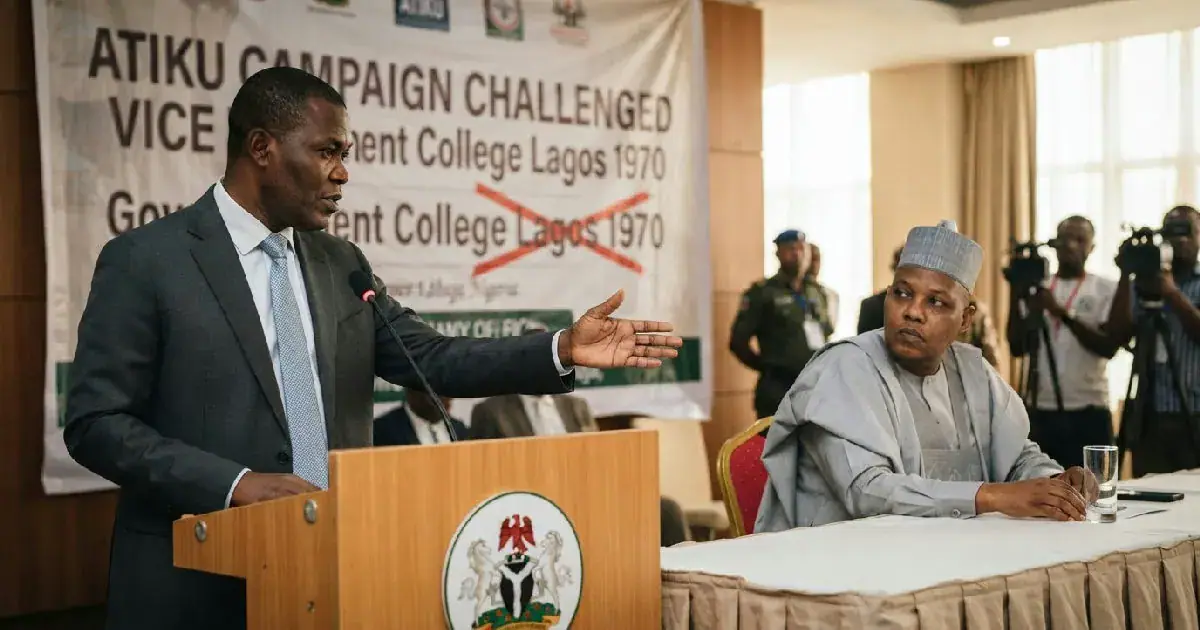
In October 2026, Phrank Shaibu, Director of Strategic Communication for the Atiku Abubakar Presidential Campaign Council, publicly challenged Vice President Kashim Shettima over President Bola Tinubu's alleged graduation from Government College Lagos in 1970. This date, however, directly conflicts with the school's reported establishment in 1974, raising serious questions about Tinubu's academic history. Shaibu demanded an explanation for this discrepancy, highlighting a persistent controversy surrounding Tinubu's educational background.
The confrontation erupted after Shettima mocked Atiku Abubakar's educational background at the Kano School of Hygiene. Shaibu quickly turned the scrutiny back to Tinubu, emphasizing the need for transparency and accountability in leadership. Documents linked to Tinubu's Chicago State University records had previously indicated his graduation from Government College Lagos in 1970, sparking concerns about the authenticity of his academic credentials.
Controversies surrounding Tinubu's academic qualifications have long shadowed his political career, resurfacing with significant intensity during the 2023 presidential election. The specific mention of Government College Lagos in his CSU records brought renewed focus to these historical inconsistencies. The Atiku campaign repeatedly pointed to this as evidence of a pattern of discrepancies in Tinubu's educational background.
In October 2023, Chicago State University Registrar Caleb Westberg testified under oath, confirming that Tinubu attended CSU from August 1977 to June 1979, earning a Bachelor of Science in Business Administration. However, Westberg stated that the replacement certificate Tinubu submitted to INEC was not a document issued by the university, and its origin could not be authenticated. This testimony created a complex legal situation, leaving many questions unanswered.
The Nigeria economic reforms under discussion often depend on public trust in leadership. Understanding the context of education in Nigeria during the 1970s is crucial, as the establishment of secondary schools followed clear administrative processes, involving government approvals and public gazetting. A major institution like Government College Lagos, established in 1974, would have had well-documented beginnings and student intake procedures, making any claim of graduation four years prior historically untenable.
Phrank Shaibu's challenge went beyond just educational records, as he accused Vice President Kashim Shettima of diverting attention from the severe economic hardships facing Nigerians. Shaibu pointed to the rising cost of food, transport, and cooking fuel, arguing that these were the real issues demanding government focus. He asserted that debating school records offered no solace to struggling families, highlighting the frustration felt by many citizens.
The persistent questions about Tinubu's qualifications served as a constant reminder of how historical details can significantly influence contemporary political battles. The World Bank estimated that nearly seven in ten Nigerians would live below the lower middle-income poverty line in 2026, providing a grim backdrop to the political sparring. The Atiku campaign's challenge underscored a deep-seated public demand for integrity and accountability from elected officials.
Key points
- The Atiku campaign challenged Vice President Shettima over President Tinubu's academic records, citing inconsistencies in his educational background.
- The controversy surrounding Tinubu's academic qualifications has long shadowed his political career, resurfacing during the 2023 presidential election.
- The challenge highlighted the importance of transparency and accountability in leadership, as well as the need for stricter verification of candidates' credentials in future elections.