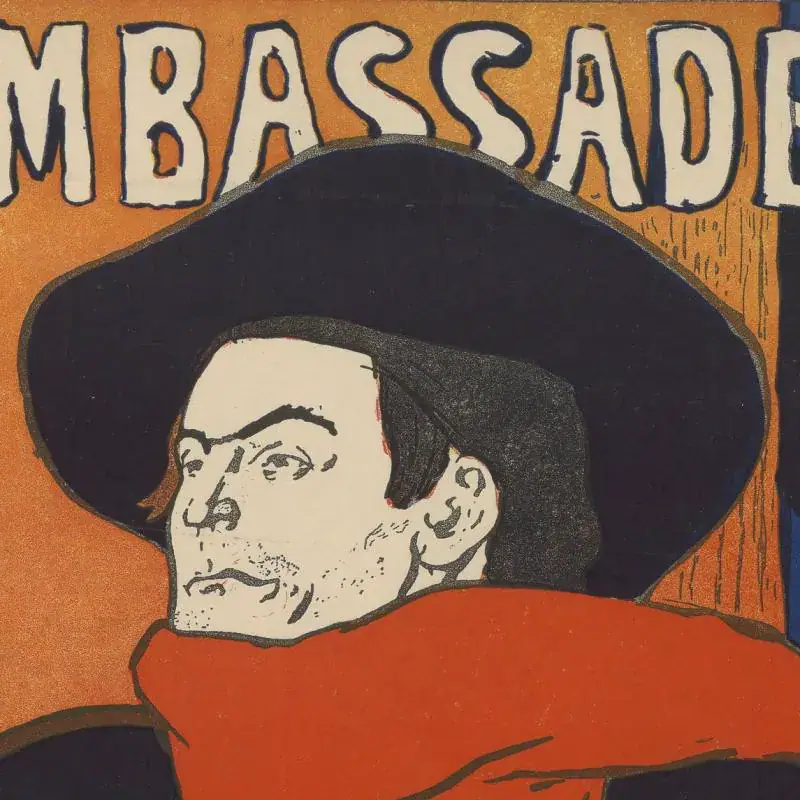
Aristide Bruant was a dominant figure in Parisian nightlife during the late 19th century. Born in 1851 in Courtenay, Loiret, he initially worked as an employee for the Chemins de fer du Nord. However, he soon grew tired of the routine and pursued a career in café-concerts, singing popular songs. It wasn't until he joined the famous Chat Noir cabaret on Boulevard de Rochechouart that he found his true calling.
At Chat Noir, Bruant replaced owner Rodolphe Salis as the "bonimenteur," the master of ceremonies who animated the audience and created a lively atmosphere. This is where he developed his unique style, writing and performing songs that portrayed the lives of Parisian outcasts, including beggars, prostitutes, and thieves. His performances quickly gained popularity, and by November 1884, L'Echo de Paris noted that "Montmartre has a new singer" who composed both the lyrics and music for his songs.
Bruant's most famous song, "La Ballade du Chat Noir," became the anthem of the cabaret and contributed to his national and international fame. His distinctive style, characterized by a black hat, cape, and red scarf, was soon immortalized in posters by Toulouse-Lautrec. This image, combined with his deep voice and dandy-like demeanor, made him an instantly recognizable figure in Paris.
In 1885, when Chat Noir moved to a new location, Bruant purchased the old venue on Boulevard Rochechouart and renamed it Le Mirliton. He ran this cabaret for ten years, developing a reputation for his bold and provocative style as a host. He would often greet bourgeois customers with hostility, insulting and teasing them, which gave them a taste of the "wild life" at a low cost.
Le Mirliton became a hub for Parisian nightlife, attracting tourists and locals alike who sought a thrilling experience without venturing into the unknown. Bruant continued to diversify his talents, publishing his songs in book form, such as "Dans la rue," which captured the spirit of the city's streets and underworld.
Reviewers of the time praised Bruant's work for its raw, unapologetic portrayal of Parisian life. His writing style, marked by the use of slang and vivid descriptions, transported readers to the city's seedy neighborhoods and cabarets. As a result, Bruant solidified his position as a leading figure in Parisian bohemia, cementing his legacy as a master of the city's nightlife.
Today, Aristide Bruant is remembered as a pioneering figure in French popular culture, with his influence extending beyond the cabarets of Montmartre to the world of art and literature. His collaborations with Toulouse-Lautrec and other artists helped shape the image of Parisian bohemia, while his music and writings continue to evoke the spirit of a bygone era.
Key points
- Aristide Bruant's unique style and performances helped establish him as a legendary figure in Parisian bohemia.
- Bruant's cabaret, Le Mirliton, became a hub for Parisian nightlife, attracting tourists and locals seeking a thrilling experience.
- Bruant's writings and music captured the spirit of Parisian life, transporting readers to the city's seedy neighborhoods and cabarets.
Reporting sources
- Le Radical · Le Radical