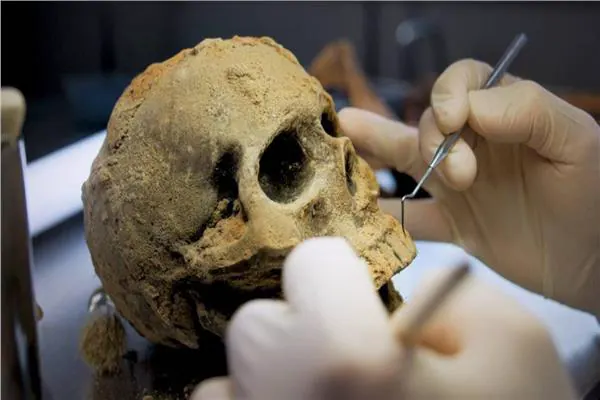
A recent study published in Frontiers in Environmental Archaeology has shed new light on an ancient Egyptian burial practice. The study analyzed 46 human skulls discovered nearly a century ago during excavations in Abydos, a site associated with the early Egyptian state. The skulls belong to individuals from the royal entourage, including officials, craftsmen, guards, and service workers, who were buried in simple tombs surrounding the royal tombs and monuments.
The analysis revealed that 18 skulls showed severe injuries likely sustained at the time of death. These injuries included fractures caused by powerful blows with flat objects or weapons, as well as cut wounds in sensitive areas of the head. These findings support an old hypothesis proposed by British Egyptologist Flinders Petrie nearly 100 years ago, suggesting that some individuals may have been killed upon the death of a pharaoh to be buried with them and continue serving in the afterlife.
The study suggests that this practice may have occurred during the First Dynasty of Ancient Egypt, between approximately 3100 and 2900 BCE. During this period, the Egyptian state was still in its early stages, and pharaohs were working to establish their power and political and religious status. However, the researchers do not necessarily believe that all individuals buried in this manner were victims of coercion, leaving open the possibility that some may have seen it as an opportunity to gain prestige or special status.
The practice of killing individuals to be buried with pharaohs appears to have been short-lived, declining with the end of the First Dynasty and the beginning of the Second Dynasty. As Egyptian funerary traditions evolved, they shifted towards more symbolic representations of service in the afterlife, such as the use of Ushabti statues, which appeared later in tombs to represent servants performing tasks on behalf of the deceased.
The study's findings not only shed light on the circumstances of death for these individuals but also provide insight into the nature of power, society, and beliefs in early Egypt. The results add to the archaeological evidence suggesting that human sacrifice associated with burial appeared in several ancient societies worldwide, albeit in different forms and with varying motivations.
While the study provides a unique window into an early stage of Egyptian civilization, the researchers acknowledge that more archaeological and anthropological evidence is needed to confirm whether the injuries represent ritual killings associated with royal death or other violent events. The discovery of these skulls raises questions about the limits of sacrifice, loyalty, and beliefs related to the afterlife in ancient Egypt.
The study's authors suggest that further research is necessary to fully understand the context and significance of these findings. As the investigation continues, it is likely that more information will come to light about the lives and deaths of these individuals and the role they played in ancient Egyptian society.
Key points
- The study provides evidence of possible ritual killings of individuals buried with pharaohs in ancient Egypt.
- The practice of killing individuals to be buried with pharaohs may have been limited to the First Dynasty of Ancient Egypt.
- The study's findings offer a unique insight into the nature of power, society, and beliefs in early Egypt.