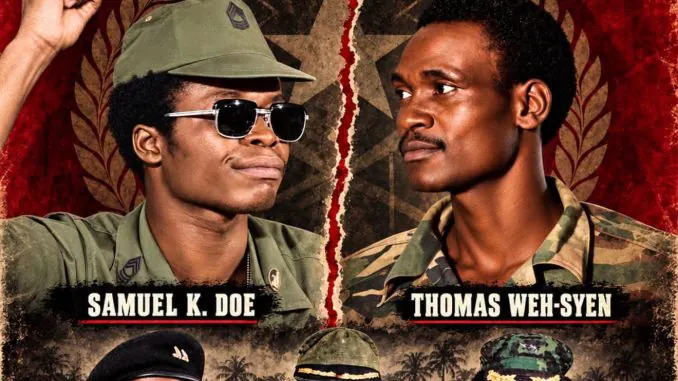
In 1980, Liberia's military, led by Samuel K. Doe, staged a coup that overthrew President William R. Tolbert Jr. This event marked the beginning of a chaotic military government that would be characterized by internal power struggles and violence. The coup itself was led by a group of soldiers who were dissatisfied with Tolbert's leadership. Doe, who held a superior military rank, emerged as the head of the People's Redemption Council (PRC), the new ruling body.
The tension within the military leadership can be traced back to the coup itself. Weh-Syen, who was the vice head of state, openly contested Doe's leadership, reportedly accusing him of cowardice for not taking part in the assault on the Executive Mansion. There were allegations that Doe had hidden in the mansion's garden until after Tolbert's death, though this claim remains unverified. This incident created a rift within the junta, with Weh-Syen and his supporters questioning Doe's legitimacy as the leader.
Competing ambitions led to a growing rivalry within the junta. Weh-Syen, supported by members like Harris Johnson and Henry Zuo, believed he was better qualified to lead. In testimony to the Truth and Reconciliation Commission, it was indicated that while Doe was provisionally appointed as chair of the PRC, this arrangement was seen merely as a temporary solution. This created an uncertain situation, with multiple factions vying for power and influence.
By early 1981, disputes over leadership, foreign policy, and financial spoils intensified, leading to a further deterioration in relations between Doe and Weh-Syen. On August 10, 1981, Doe accused Weh-Syen and four others of plotting against him. Just three days later, they were sentenced to death and executed. This event marked a turning point in the power struggle, with Doe eliminating his rivals without a fair hearing.
The executions were widely condemned by human rights organizations. Amnesty International criticized the trials for lacking fairness, and a subsequent US Senate report suggested there was no credible evidence supporting the conspiracy charges against Weh-Syen and his colleagues. Despite this, Doe continued to consolidate his power, using the executions to eliminate his rivals and cement his position as the leader of the PRC.
Even after Weh-Syen's execution, accusations persisted. Doe implicated him in the deaths of Tolbert and former police chief Varney Dempster. These allegations further highlighted the complex web of alliances and rivalries within the junta, with different factions vying for power and influence. The executions underscored the lethal nature of discord within the government, as Doe eliminated his rivals without a fair hearing.
The power struggle within Liberia's military junta had significant consequences for the country. The events of 1980 and 1981 set the stage for future conflicts, with Doe facing challenges from his former comrades. The legacy of this period continues to shape Liberia's politics, with the country's leaders grappling with the consequences of the violent power struggles that characterized the early years of the PRC.
Key points
- The 1980 military coup in Liberia led to a power struggle within the junta, resulting in the execution of several leaders, including Thomas Weh-Syen and Nelson Toe.
- The executions were widely condemned by human rights organizations, who criticized the trials for lacking fairness.
- The power struggle within Liberia's military junta had significant consequences for the country, setting the stage for future conflicts.