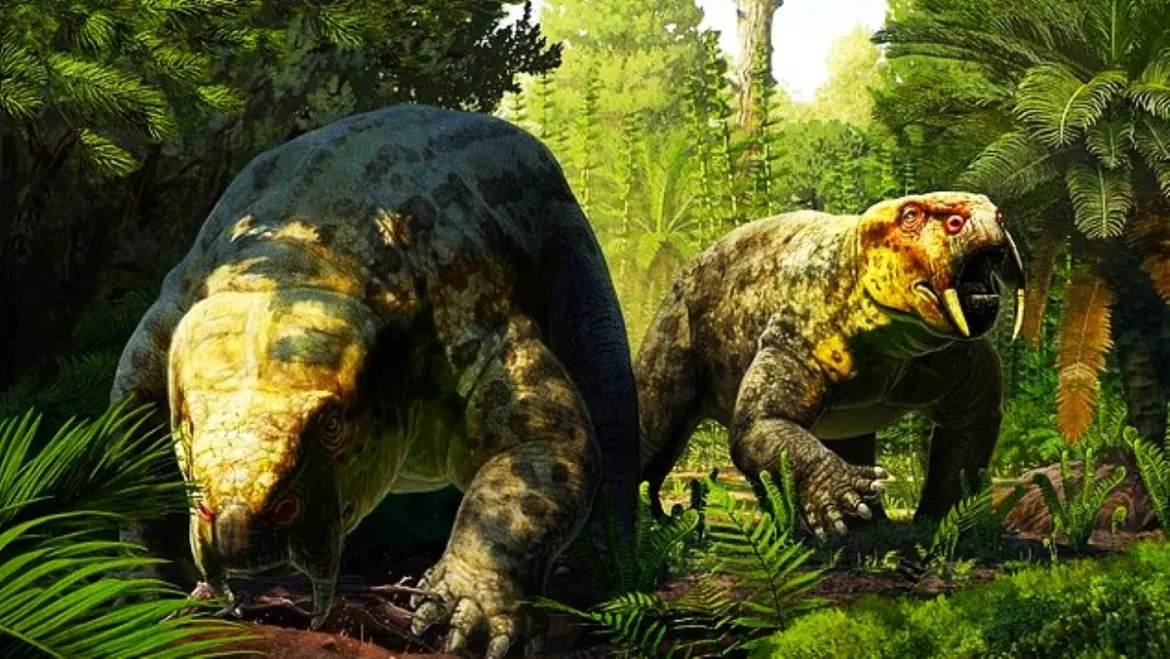
A team of scientists has identified a previously unknown species of giant tusked creature that roamed present-day Tanzania around 240 million years ago. The animal, named Dinodontosaurus isiyavamanda, belonged to a group of mammal relatives called dicynodonts. It was the dominant herbivore of its time and would have moved around in herds. Despite being a plant-eater, its distinctive beak and enormous tusks meant it could have caused serious damage to any predator that targeted it.
The fossils of Dinodontosaurus isiyavamanda were first unearthed in Tanzania in the 1960s and were housed at the Natural History Museum in London. However, it wasn't until now that they were fully examined. Dr. Mike Day, curator of non-mammalian tetrapods at the museum, said that the fossil specimen from Tanzania has been in their care for over 60 years, and it's wonderful that its identity has now been brought to light.
The analysis, led by a team from the University of Bristol, found that Dinodontosaurus isiyavamanda would have been capable of delivering a painful bite. The patterns on its tusks suggest they may have been used to forage and dig up plant roots, but they could also have been useful for fighting or defending themselves against predators. The discovery could have implications far beyond the strange-looking creature.
Until now, animals that belonged to the genus Dinodontosaurus have only been found in South America. However, the Tanzanian rocks containing the fossils are also home to remains previously thought to represent some of the oldest potential dinosaurs. The new discovery suggests that those rocks may not be as old as scientists had previously believed.
Since Dinodontosaurus is now known from both Tanzania and South America, the researchers were able to link the geological sequences in the two regions and show that they are of equivalent age. Radiometric dating from South America suggests these dinosaur-bearing rock sequences could be up to ten million years younger than equivalent rocks in South Africa.
The discovery prompts scientists to reassess when and where dinosaurs first evolved. Lead author Hady George said that the finding links the Tanzanian and South American fossil-bearing rocks, showing they are of equivalent age. This helps confirm that the oldest dinosaur candidates from Tanzania are probably no older than those from South America.
Forthcoming research projects will examine the remaining fossil material and explore the biomechanics and ecology of Triassic dicynodonts. The discovery of Dinodontosaurus isiyavamanda provides a glimpse into the planet's past, 240 million years ago. The fossilised remains of the front of the cranium and lower jaw of the animal show a turtle-like beak and enormous tusks.
Key points
- The discovery of Dinodontosaurus isiyavamanda in Tanzania provides evidence of the animal's existence 240 million years ago.
- The finding links the Tanzanian and South American fossil-bearing rocks, showing they are of equivalent age.
- The discovery prompts scientists to reassess when and where dinosaurs first evolved.