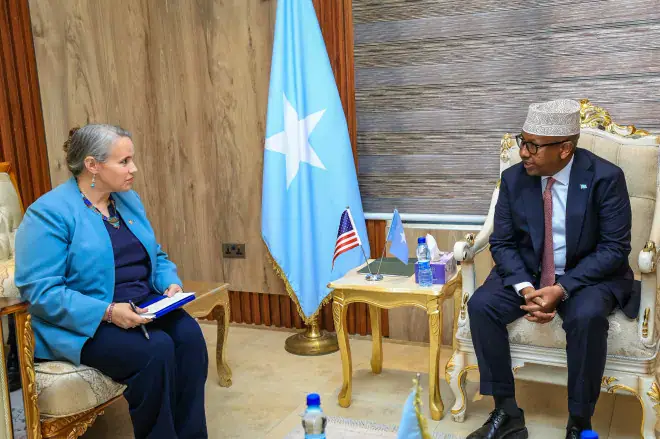
Somali Defense Minister Ahmed Moallim Fiqi met with US Embassy Chargé d’Affairs Ruth Anne Stevens-Klitz in Mogadishu on Sunday to discuss military cooperation and the transfer of security responsibilities from African Union forces to the Somali National Army. The meeting focused on ongoing operations against al-Shabab and ISIS, and Somalia's security transition plan. Both sides discussed the importance of ensuring that Somali security forces have the necessary training, equipment and operational capacity.
Fiqi briefed the US diplomat on military operations against al-Shabab and reaffirmed the federal government's commitment to building a capable national army that can maintain security and protect Somalia's sovereignty. The discussions also addressed the recent handover of a former African Union Support and Stabilization Mission in Somalia (AUSSOM) military base in Barawe, Lower Shabelle region, to the Somali National Army. This transfer is part of ongoing efforts to gradually shift security responsibilities from African Union forces to Somali troops.
The meeting comes as Somalia prepares to assume greater responsibility for its security amid continuing military operations against al-Shabab and concerns over the pace of the African Union troop withdrawal. The United States remains a key security partner for Somalia, providing training and operational assistance to Somali forces involved in counterterrorism operations. The federal government has repeatedly emphasized that a successful security transition will depend on strengthening the capabilities of Somali troops.
Fiqi emphasized the importance of continued US assistance, particularly in military training, capacity-building and operational support for Somali forces. The Somali government is working toward greater control of its national security operations, and the US is providing critical support. Somalia is preparing to take on more security responsibilities, and the US is helping to ensure that Somali forces are equipped to handle these new responsibilities.
The discussions between Fiqi and Stevens-Klitz also highlighted the need for coordination between Somali security forces and international partners. A successful security transition will require close cooperation between Somalia and its international partners, including the US. The US has been a key partner for Somalia in the fight against terrorism, providing military training and operational assistance.
The meeting between Fiqi and Stevens-Klitz did not result in a new military assistance package or formal agreement. However, the discussions demonstrated the ongoing commitment of the US and Somalia to work together on security issues. The two countries have a long-standing partnership on security and counterterrorism issues, and the meeting helped to reinforce this partnership.
The security transition in Somalia is a critical issue, with implications for regional stability and security. The country is working to build a capable national army that can maintain security and protect its sovereignty. With continued support from international partners, including the US, Somalia is making progress toward a successful security transition and a more stable future.
Key points
- The Somali government is working to build a capable national army that can maintain security and protect its sovereignty.
- The US is providing critical support to Somali forces, including military training and operational assistance.
- A successful security transition in Somalia will depend on strengthening the capabilities of Somali troops and maintaining coordination with international partners.