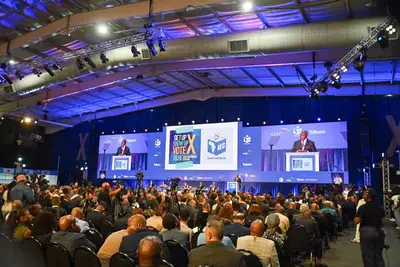
The African National Congress (ANC) has emerged as the largest party in the 2026 local government elections, securing 30.76% of the vote and 3246 council seats. However, this marks a significant decline in its dominance over municipal councils. The Democratic Alliance (DA) came second with 24.64% of the vote and 1695 seats, while ActionSA secured 5.67% of the vote and 313 council seats.
The Electoral Commission of South Africa (IEC) confirmed the final results, revealing a highly fragmented political landscape. No single party achieved an outright majority across most municipalities. The IEC reported that 142 municipalities have hung councils, a significant increase from 70 in the 2021 local elections. This shift indicates a more balanced distribution of political power at the local level.
The uMkhonto weSizwe party (MKP) received 9.76% of the vote, securing 785 seats, followed by the Economic Freedom Fighters (EFF) with 6.22% and 588 seats. Independent candidates collectively secured 22.9% of the vote, gaining representation across various municipal councils. This surge in independent candidates' success further contributes to the fragmented political landscape.
Despite being the largest party nationally, the ANC only secured outright control in 53 municipalities and emerged as the leading party in 128. In contrast, the DA secured outright control in 12 municipalities and led in 32. The Inkatha Freedom Party (IFP) controlled five municipalities and led in 19, while the MKP secured control in three municipalities and led in 19.
The IEC's chief electoral officer, Sy Mamabolo, highlighted the significance of the elections as an expression of citizens' constitutional rights. He described the electoral process as one of the most complex operations undertaken by a public institution, requiring extensive coordination of operational, logistical, and administrative systems nationwide.
Technology played a crucial role in the elections, with the IEC deploying 56,000 voter management devices (VMDs), including 16,000 additional devices donated by the Gauteng provincial government. These devices constituted the technological backbone of election-day operations, allowing the commission to monitor activities at voting stations.
The elections saw a turnout of 15.6 million voters. The IEC's operations were extensive, involving the mobilisation of 188,000 electoral personnel to administer 23,696 voting stations and manage over 100 million ballot papers. The commission also printed more than 100 million ballot papers for the 2026 elections, following a Constitutional Court ruling that allowed the reinstatement of certain councillor candidates.
Key points
- The ANC secured 30.76% of the vote and 3246 council seats.
- The DA came second with 24.64% of the vote and 1695 seats.
- 142 municipalities have hung councils, a significant increase from 70 in the 2021 local elections.
Reporting sources
- ANC barely hangs on as DA and ActionSA make gains in final IEC results · Mail & Guardian