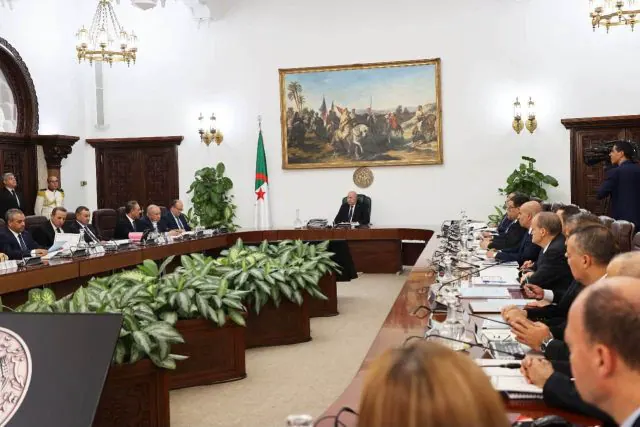
On October 6, 2026, President Abdelmadjid Tebboune chaired a Council of Ministers meeting, where he requested the Minister of Agriculture, Rural Development, and Fisheries, as well as the Secretary General of the Government, to dedicate a special council to the agricultural sector. This move comes after the president's instructions on September 20, 2026, to prepare a more effective agricultural orientation law.
The new law aims to allocate cultivated areas to annual crops based on needs, reducing imports and increasing self-sufficiency in the sector. President Tebboune also ordered the Minister of Agriculture to develop a monthly bulletin to track production levels and volumes of various cereal varieties, including soft and hard wheat.
The president emphasized the importance of digitizing the payment system for agricultural harvests at regional agencies of the Algerian Interprofessional Office for Cereals (OAIC). He also instructed the office to work closely with the National Office of Statistics (ONS) and review the role of OAIC and specialized institutes to improve their performance and modernize the sector.
Furthermore, President Tebboune ordered the launch of a national program to map and study soils, in coordination with laboratories, to determine and classify the nature of agricultural land in all cultivated areas. The goal is to promote the use of treated wastewater for irrigation and shift away from relying solely on rainfall.
Experts view this approach as a refoundation of agricultural policy, taking into account current data and transformations in the sector, particularly related to climate change. The expected outcome is the reintroduction of planning in agricultural production activities to meet the needs of the Algerian population and reduce import fluctuations.
The modernization of the agricultural sector will be driven by digitalization, scientific research, and artificial intelligence, accompanied by electrification, new technologies, and drones. Algeria aims to accelerate agricultural mechanization to optimize harvest operations and reduce post-harvest losses through the introduction of new technologies and precision agriculture.
The ultimate goal is to enhance food security in the country by increasing productivity, optimizing resources, and developing agro-food industries. To achieve this, accurate and reliable data are essential, which will be facilitated by the upcoming harvest campaign and the creation of a monthly bulletin.
Key points
- Algerian President Abdelmadjid Tebboune has ordered a special council to focus on the agricultural sector.
- The new agricultural orientation law aims to reduce imports and increase self-sufficiency in the sector.
- The modernization of the agricultural sector will be driven by digitalization, scientific research, and artificial intelligence.