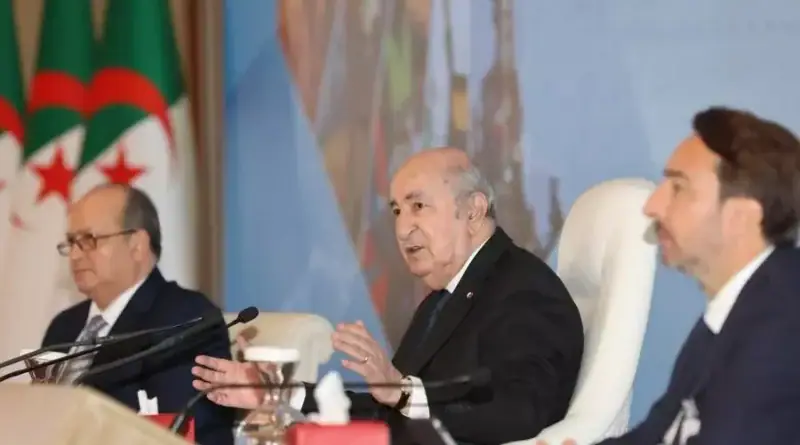
Algerian President Abdelmadjid Tebboune recently highlighted the country's positive economic indicators, stating that the national economy has made significant progress in recent years. Previously, the economy was heavily dependent on oil revenues and suffered from unregulated imports. However, President Tebboune noted that the economy has undergone a substantial transformation, with a focus on developing various sectors and reducing reliance on imports.
According to President Tebboune, the Algerian economy has become the third-largest in Africa, and the country aims to continue improving its economic standing. He emphasized that the government has been working to address existing shortcomings and rationalize imports in a structured manner. The President also highlighted Algeria's transition from an administered economy to a free economy, noting that this shift requires careful management to avoid economic instability.
President Tebboune stressed the importance of mastering economic data to enable Algeria to become self-sufficient. He reaffirmed the government's commitment to its social role, stating that the state must intervene in certain sectors, particularly those with social implications. The President aims to achieve a strong economy that balances growth with social responsibility by 2027.
The Algerian economy has shown significant improvements, with imports decreasing by $40-42 billion. President Tebboune noted that the country no longer imports gasoline and kerosene and will cease importing diesel once the new Hassi Messaoud refinery is operational. Additionally, Algeria now produces 84% of its medication needs, including complex medicines for diabetes and cancer patients.
The industrial sector has also seen growth, with its contribution to the GDP increasing by 10%. President Tebboune highlighted the emergence of new factories and the agricultural sector's 15% contribution to the GDP. The government aims to achieve self-sufficiency in cereal production by 2027 and has invested in oil and sugar production.
President Tebboune discussed Algeria's plans to develop its automotive industry, with a goal of producing a fully Algerian-made vehicle by the end of 2028. He expressed confidence in the country's ability to achieve this goal, which is part of a broader effort to reduce dependence on hydrocarbons and promote economic diversification.
The President also highlighted the importance of investment in Algeria's economic growth, with 13,000 real investment projects underway. A new one-stop shop for investment will be launched on January 1, 2027, which aims to attract national and foreign investment. President Tebboune emphasized the need for collective mobilization to increase non-hydrocarbon exports and promote economic growth.
Key points
- Algerian President Abdelmadjid Tebboune emphasizes the country's positive economic indicators and its transition to a free economy.
- The Algerian economy has become the third-largest in Africa, with a focus on reducing import dependence and promoting economic diversification.
- President Tebboune aims to achieve a strong economy that balances growth with social responsibility by 2027.