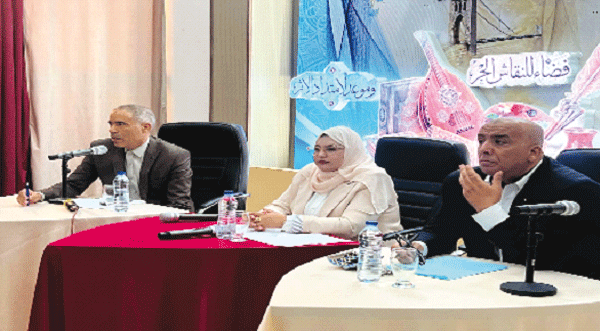
A national festival of the book, held in Constantine, concluded with a scientific symposium titled "Emir Abdelkader in Contemporary Historical, Literary, and Intellectual Studies: Approaches and Critical Views." The event was organized in collaboration with the Oran Academy of Scientific Studies and Cultural Interaction. Historians and academics emphasized the need to revisit the life and experiences of Emir Abdelkader, who embodied multiple dimensions, including thought, mysticism, politics, literature, and psychology.
The symposium featured various presentations that explored different aspects of Emir Abdelkader's personality, highlighting his comprehensive genius and lasting impact on Algerian and global history. Participants noted that Emir Abdelkader's experience in building a modern state and his military tactics continue to be studied in various countries. The event aimed to encourage a deeper understanding of Emir Abdelkader's life and legacy, moving beyond celebratory narratives to critically examine his intellectual, historical, and literary contributions.
The symposium's opening session was led by Professor Ahlam Chemri from the University of Constantine, who emphasized the importance of reevaluating historical figures through a critical lens. She highlighted Emir Abdelkader's significance as a multifaceted personality whose presence continues to be felt in Algerian, Arab, and global cultural and intellectual discourse. Emir Abdelkader's literary representation in poetry, novels, theater, and historical writing was also discussed, showcasing his enduring influence on literature and art.
Bouabeker Souheili, head of the Emir Abdelkader Foundation in Tiaret, presented a paper that included titles of books about Emir Abdelkader's life and legacy, both locally and internationally. He cited a book by Muhammad Sharif Al-Sadi, "Emir Abdelkader, the Knight of Faith," and another by Ismail Al-Arabi, which highlighted Emir Abdelkader's resistance to French occupation. Souheili argued that French colonial attempts to distort the legacies of national heroes like Emir Abdelkader continue to this day.
Souheili also discussed Emir Abdelkader's formative experiences, including his travels to Tunisia, Libya, Egypt, and Syria, which shaped his leadership, thought, and culture. He emphasized Emir Abdelkader's commitment to knowledge and education, citing his reaction to the destruction of libraries and loss of manuscripts during the French occupation. Additionally, Souheili refuted claims that Emir Abdelkader's truce with French colonial forces was aimed at fighting Ahmed Bey, stressing that Emir Abdelkader's goal was to reorganize and strengthen his position.
Mohamed Draaou, a researcher at the National Center for Studies and Research on Popular Resistance and the National Movement, highlighted Emir Abdelkader's central role in Algerian history, describing him as a rare figure with exceptional charisma and qualities. Draaou discussed Emir Abdelkader's strategy for building a modern state, based on knowledge and competence, and his efforts to promote justice and surround himself with scholars and influential figures.
The symposium also touched on Emir Abdelkader's relationship with scholars, including his close ties with the scholar and poet Muhammad Al-Shadhili Al-Qasantini. Researchers emphasized the importance of exploring this relationship, which was characterized by mutual respect and a shared commitment to resistance and intellectual pursuits. The event concluded with a call for further research into Emir Abdelkader's life and legacy, encouraging a new generation of scholars to engage with his multifaceted experiences and contributions.
Key points
- Historians and academics in Constantine, Algeria, have launched a call to renew studies on Emir Abdelkader, highlighting his comprehensive genius and lasting impact on Algerian and global history.