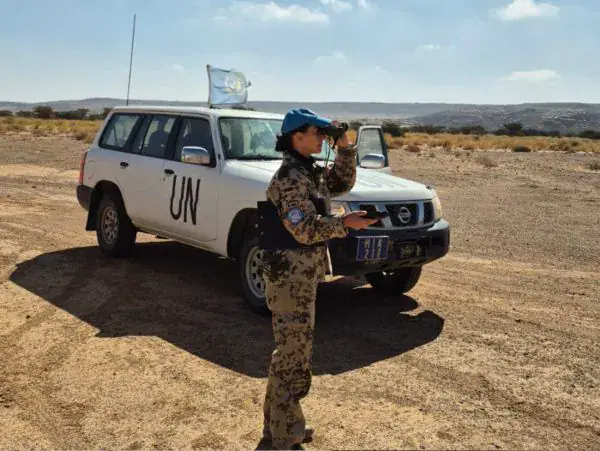
Algeria's Foreign Minister, Ahmed Attaf, expressed deep regret over the non-renewal of the UN Mission for the Referendum in Western Sahara's (MINURSO) mandate, which expired on October 31. The minister stated that the resolution proposed by the US was biased in favor of Morocco, undermining the Sahrawi people's right to self-determination. Algeria warned the international community about the consequences of such a resolution, highlighting the risk of legitimizing Morocco's occupation of Western Sahara.
The Algerian government released a statement criticizing the UN resolution, saying it imposed a plan of autonomy under Moroccan sovereignty as the only basis for discussion. This, they argue, restricts the field of negotiations and predetermines their outcome, effectively confiscating the Sahrawi people's freedom of choice. The statement also noted the removal of the letter "R" from MINURSO's acronym, which Algeria sees as a symbolic but significant change that dismisses the referendum option.
The conflict over Western Sahara dates back to 1975, when Spain withdrew from the territory. Morocco claims sovereignty over Western Sahara, while the Polisario Front, supported by Algeria, demands total independence for the Sahrawi Arab Democratic Republic. In 1991, a ceasefire was agreed upon under UN auspices, and MINURSO was established to organize a referendum. However, the process has been stalled due to disagreements over the composition of the electoral body.
Algeria's Foreign Minister had addressed official démarches to the members of the Security Council before the vote, warning them about the critical consequences of such a resolution. Despite some amendments, the final text maintained an orientation that Algeria finds unacceptable. The government emphasizes that any durable solution must be based on the inalienable right to self-determination.
The Algerian government also denounces an attempt to transform the Western Sahara issue from a decolonization matter into a simple humanitarian problem. They argue that this approach would legitimize the acquisition of territories by force and weaken international legal instruments. Algeria reaffirms its commitment to a just and political settlement, in line with the UN Charter and resolutions.
The tension between Algeria and the international community over Western Sahara has been ongoing for decades. The Sahrawi people's right to self-determination remains a central issue, with Morocco advocating for autonomy under its sovereignty and the Polisario Front pushing for independence. Algeria's reaction to the UN resolution reflects its long-standing support for the Sahrawi cause.
The situation in Western Sahara remains a major point of friction in North African geopolitics. Algeria's condemnation of the UN resolution highlights the complexities of the conflict and the challenges of finding a solution that satisfies all parties involved. The international community must navigate these complexities to ensure a just and lasting resolution to the Western Sahara issue.
Key points
- Algeria criticizes UN resolution on Western Sahara for bias towards Morocco.
- The resolution undermines the Sahrawi people's right to self-determination.
- Algeria reaffirms its commitment to a just and political settlement in line with UN principles.