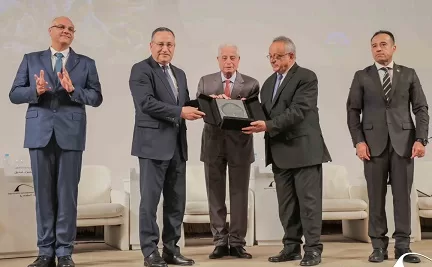
The Alexandria Library recently concluded a three-day conference titled "National Identity: Rooted and Renewed," which was attended by Egyptian President Abdel Fattah El-Sisi. The conference resulted in the launch of the "Alexandria Library Document on National Identity." The closing session was attended by high-ranking officials, including Dr. Abdel Aziz Kansoua, Minister of Higher Education and Scientific Research, and Dr. Khaled Foda, advisor to the President for Local Development.
The conference provided a platform for discussing the Egyptian identity and its components, as well as the challenges it faces. Dr. Khaled Foda stated that the conference represented a genuine opportunity for dialogue on the issue of Egyptian identity. He emphasized that the sessions went beyond exchanging opinions and delved into discussing ways to preserve national identity and present it to new generations in a way that keeps pace with the changes of the era.
Dr. Foda also announced that the conference will be held annually, with its activities expanded to various governorates in Egypt, and that the opinions of Egyptians abroad will be taken into account. He stressed the importance of building an identity that is proud of its history and culture, preserves its values, and is capable of interacting with the developments of the era and absorbing evolution and openness to science and creativity.
Dr. Ahmed Zayed, director of the Alexandria Library, reviewed the main axes of the national identity document, which include a definition of identity, theoretical premises, motivations, basic pillars, strategic goals, and mechanisms for application. He stated that the document is the result of a wide societal dialogue and a partnership between government, civil, and private sectors to enhance national identity as a basis for social cohesion and citizenship.
The document aims to establish a comprehensive and renewed identity based on the common cultural foundations of Egyptians and accommodates their diversity. Dr. Zayed pointed out that the document addresses several parties within the framework of societal partnership, including family, education, media, religious and cultural institutions, civil society, and entities concerned with communicating with Egyptians abroad.
The document highlights that the Egyptian identity is based on integrated historical foundations that give the people their steadfastness and continuity, including the unity of Egyptian land, connected historical memory, the Arabic language as a tool of communication and cultural container, a system of spiritual and moral values, the richness of cultural heritage, national symbols, and fair citizenship.
The launch of the document comes at a time when Egyptian society faces several challenges, including digital and societal transformations. The document seeks to confront these challenges and consolidate awareness to face them, with a focus on empowering the Arabic language as a meeting point for knowledge and a means of communication.
Key points
- The Alexandria Library's national identity document aims to establish a comprehensive and renewed identity based on Egypt's cultural foundations.
- The document was produced through a partnership between government, civil, and private sectors.
- The launch of the document seeks to promote national belonging and confront societal challenges.