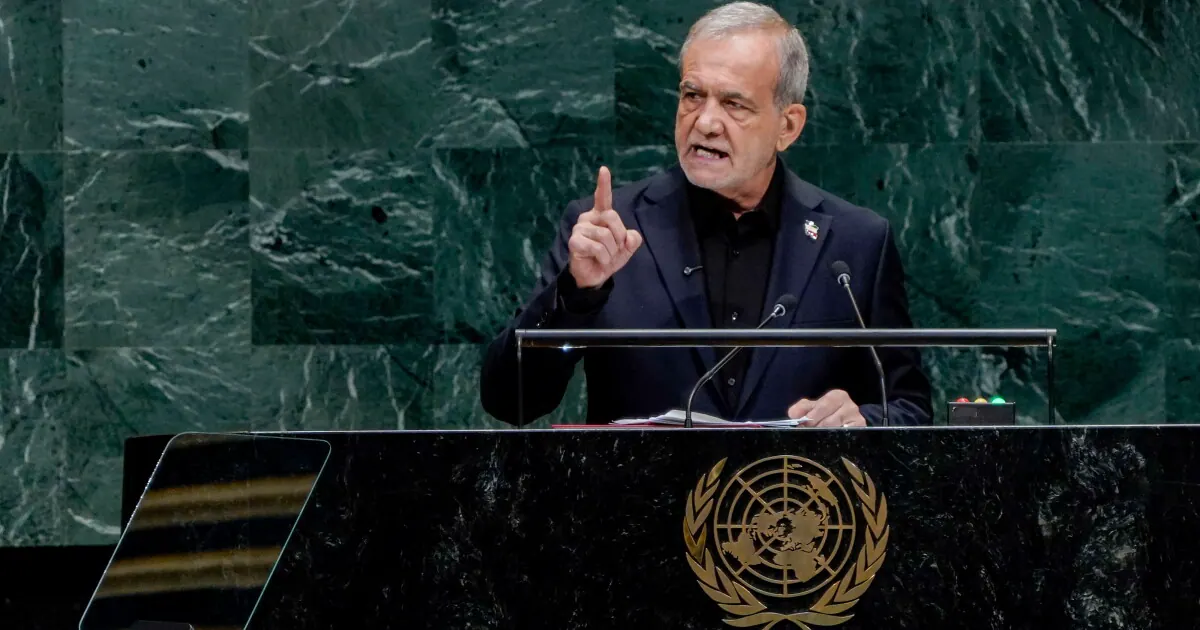
Iranian President Masoud Pezeshkian delivered a rare wartime speech at the United Nations General Assembly on September 23, 2026, in response to escalating tensions with the United States. The speech came a day after US President Trump threatened to "annihilate" Iran from the same podium. Pezeshkian countered by describing Iran as victims of terrorism, referencing Trump's previous remarks.
During his address, Pezeshkian held up a portrait of the late Ayatollah Ali Khamenei and photos of children he claimed were victims of a US bombing of an Iranian school. This emotional appeal was a stark contrast to the aggressive rhetoric employed by President Trump. The Iranian leader emphasized his country's desire for dialogue and diplomacy, while rejecting the language of force.
President Trump's remarks at the UN General Assembly on Tuesday had heightened tensions between the two nations. He stated that he faced a crucial decision: to make a deal with Iran that would allow them to rebuild or to "annihilate the Islamic Republic." Trump also reiterated his commitment to preventing Iran from developing a nuclear weapon.
In a subsequent development, US Ambassador to the UN Mike Waltz revealed that US officials had met with Iranian representatives for three hours. Waltz stated that the administration was "internalizing what they brought to the table," hinting at potential diplomatic efforts.
Iran's Foreign Ministry spokesperson, Esmail Baghaei, confirmed that an exchange of messages between Iran and the US had taken place, mediated by Qatar. According to Baghaei, Iran's conditions for negotiations included a halt to US hostilities, an end to the US naval blockade of Iranian ports, and the release of Iranian funds.
President Pezeshkian reiterated Iran's stance on its nuclear program, denying any intention to develop a nuclear weapon while refusing to accept limitations on the country's civilian nuclear program. He expressed a willingness to engage in negotiations, stating that Iran was "ready for dialogue and diplomacy and negotiations without accepting the language of force."
The diplomatic efforts between Iran and the US are ongoing, with both sides seemingly open to negotiations. However, significant differences remain, and it is unclear whether a mutually acceptable agreement can be reached. The international community is watching closely, as the situation continues to unfold.
Key points
- Iran's President Pezeshkian delivers a speech at the UN General Assembly, responding to US President Trump's threats.
- Pezeshkian expresses willingness for dialogue and diplomacy, while rejecting limitations on Iran's civilian nuclear program.
- Diplomatic efforts between Iran and the US are ongoing, with Qatar acting as a mediator.