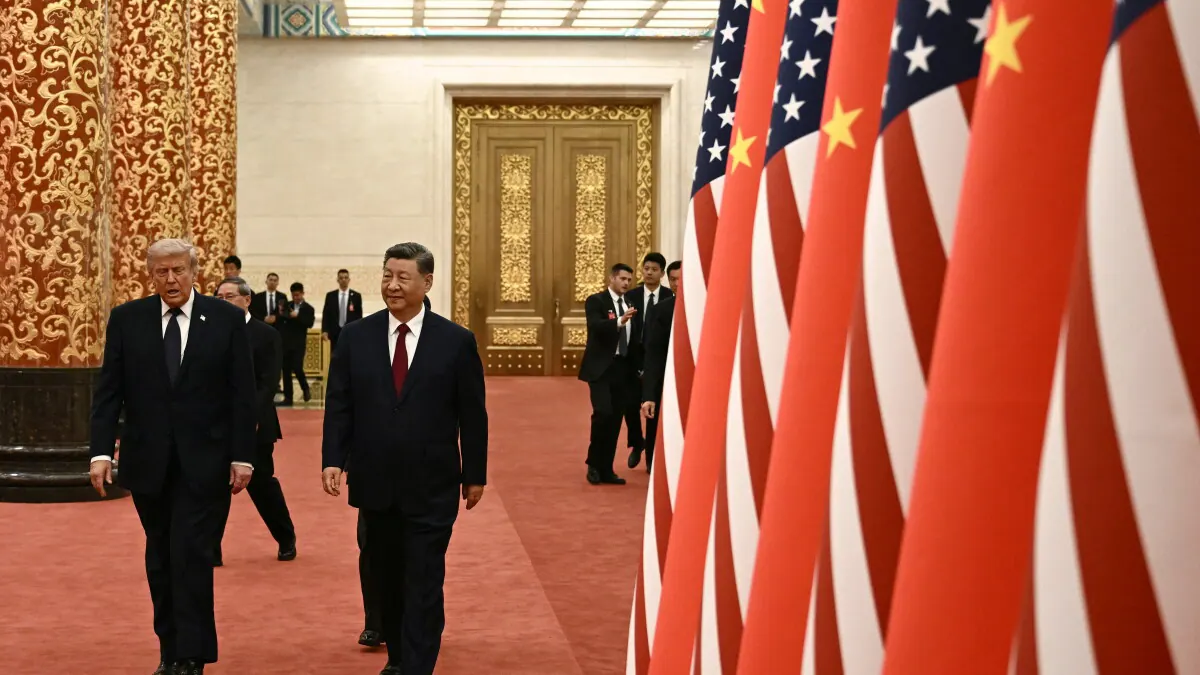
Chinese leader Xi Jinping is set to arrive in the United States on Wednesday evening for his first state visit in 11 years. This visit comes at a pivotal moment for both leaders, as they face challenges at home. For Trump, the visit occurs just over a month before the midterm elections. For Xi, preparations for the all-important Party Congress start when he returns to Beijing. The two leaders are trying to shore up power at home and project a willingness to build a relationship of "constructive strategic stability."
Despite the projected willingness to build a stable relationship, fierce negotiations over weighty subjects such as AI and trade are underway. US Treasury Secretary Scott Bessent said in a Fox News interview in July that the Chinese seem to have done a lot of kicking lately, and the US will kick back if necessary. The relationship has been described as "fragile" since Trump's visit to China, which included pageantry and a state banquet at Beijing's Great Hall of the People.
Wu Xinbo, who directs the American Studies center at Shanghai's Fudan University, said Trump's visit was the warmest he had seen in US-China relations in years. However, since then, things have been more fragile due to US actions such as imposing extra tariffs on Chinese exports over forced labor claims. The Pentagon added Chinese tech giants on a military blacklist, and the Federal Communications Commission banned new imports of Chinese humanoid robots and robot dogs over national security concerns.
International studies professor Zhang Yun at Nanjing University said ups and downs are to be expected in a relationship as complicated as the US and China's. The key is to build high-level channels to deal with problems as they emerge and mitigate the negative impacts. Zhang said Taiwan, tech, and trade are high on Xi's agenda this trip. Discussions on the wars in Iran and Ukraine, plus tensions along the Korean peninsula, are also expected.
The US is expected to reciprocate the high level of pomp and circumstance for Xi, regardless of the tough negotiations expected. Trump has publicly held Xi in high regard. US Trade Representative Jamieson Greer said this week that the two countries are still negotiating the potential extension of a rare earths truce that would ensure continued flow of Chinese rare earth products for the US. China dominates the refining of rare earths and other critical minerals important to manufacture a range of products.
Trump and Xi are also expected to talk about AI governance. China has been trying to figure out what kind of guardrails or controls can be put on artificial intelligence. Rose Gottemoeller, a former NATO official, said it's a combination of older issues related to nuclear stability and new issues related to new technology. China is interested in imposing safety measures, but there is a lot of mistrust between the US and China on the proposed solutions.
Taiwan is also on the table, with Xi repeatedly emphasizing to Trump that Taiwan is a red line and if mishandled could put the US-China relations in jeopardy. Experts say Xi is expected to press Trump to maintain momentum on Taiwan when he sits down with Trump. Trade discussions are also underway, with Trump and Xi agreeing to create trade and investment boards back in May. China is expected to announce purchases of American agricultural products, and the US is expected to announce tariff reductions on certain consumer goods.
Key points
- The US and China are negotiating the potential extension of a rare earths truce.
- Taiwan is a key issue on Xi's agenda, with China claiming the self-governing island as its own.
- The two leaders are trying to shore up power at home amid high-stakes talks.