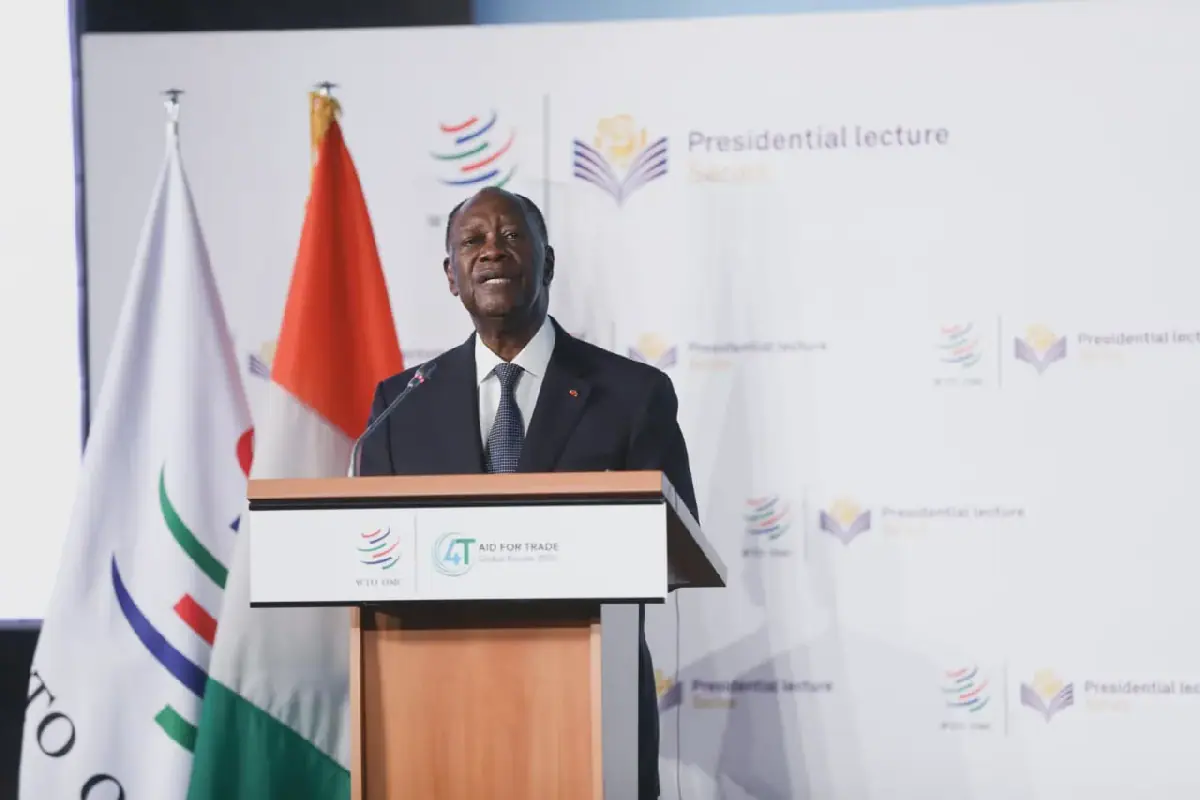
Ivorian President Alassane Ouattara recently spoke at the ninth presidential conference of the World Trade Organization (WTO) in Geneva, where he emphasized the importance of a more inclusive form of globalization. He highlighted the need for investment in productive sectors, local transformation of raw materials, and better access to regional and international markets. Ouattara's intervention took place on the sidelines of the 2026 Aid for Trade Global Review, which brought together trade and development actors to examine the results of initiatives in favor of development.
The conference, which took place at the WTO headquarters in Geneva, was attended by ministers, leaders of international organizations, and experts. The Director-General of the WTO, Ngozi Okonjo-Iweala, introduced Ouattara, recalling his country's dynamic economic growth over the past decade. She noted that Côte d'Ivoire is one of the most dynamic economies in Africa. Ouattara presented his country's experience, illustrating the potential of economic reforms, investments in infrastructure, and industrial policies to strengthen the position of developing economies in global trade.
According to Ouattara, international trade is a driver of growth, opening up new markets, facilitating the diffusion of technologies, and promoting the integration of enterprises into global value chains. However, he stressed that developing countries must be able to reap the full benefits of international trade. He noted that an economy that exports mainly raw materials while importing manufactured products with high added value risks remaining in a situation of dependence. To overcome this, Ouattara emphasized the need to strengthen local production and transformation capacities.
The Ivorian president highlighted his country's progress in local transformation, citing the example of cocoa, which was transformed locally at a rate of 41% during the 2024-2025 campaign. He also noted that the share of cashew nuts transformed locally had increased from 2% in 2012 to 43% in 2025, with a target of 80% by 2030. Ouattara emphasized that this transformation must be at the heart of Côte d'Ivoire's development strategy, which is set out in the National Development Plan (PND) 2026-2030.
The PND 2026-2030 aims to consolidate the country's productive capacities while making growth a lever for reducing poverty and inequalities. Ouattara noted that private investment will play a key role in this plan, with a target of more than 70% of investments mobilized. The plan prioritizes agro-industry, modernization of infrastructure, strengthening of human capital, promotion of private investment, and improvement of governance. Ouattara also highlighted Côte d'Ivoire's good performance in the evaluation of policies and national institutions by the World Bank for 2025.
Côte d'Ivoire ranked second among African countries evaluated, behind Rwanda, and first in West Africa, with a score of 4 out of 6. Ouattara also recalled the implementation of an economic and financial program with the International Monetary Fund (IMF), which includes reforms related to climate sustainability. He emphasized that these indicators must translate into tangible results, such as an increase in productive investments, more competitive enterprises, effective technology transfers, and the creation of decent jobs.
Ouattara's speech was part of a broader debate on "re-globalization," advocated by the WTO Director-General, Ngozi Okonjo-Iweala. This approach aims to rethink globalization rather than renounce it, by diversifying value chains and allowing more countries to benefit from the opportunities offered by international trade. For developing economies, the challenge is to move beyond the export of primary products and take a greater place in industrial transformation, innovation, and commercialization.
Key points
- Côte d'Ivoire aims to increase local transformation of raw materials, with a target of 80% of cashew nuts transformed locally by 2030.