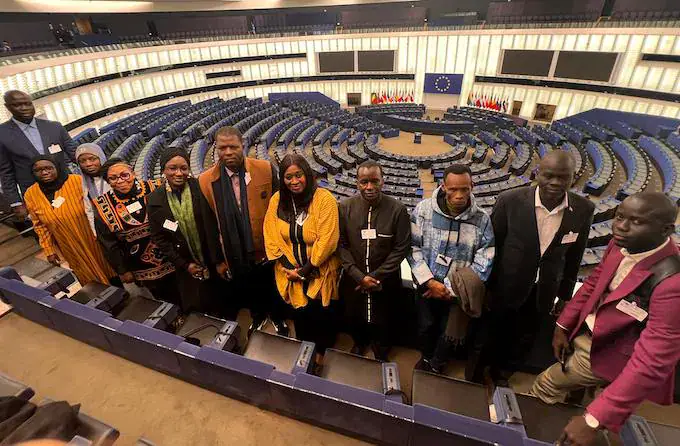
The third edition of the Dakar-Strasbourg program, run by the Afro-European platform Médias & Démocratie, wrapped up on November 20, 2026, in Strasbourg. The program brought together journalists from Senegal, Guinea, Cameroon, and Chad for a two-part training program. The first part, held in Dakar, focused on theoretical foundations, while the second part, in Strasbourg, provided immersive training. The program aimed to address challenges faced by journalists, including disinformation, artificial intelligence, and eroding public trust in media.
The training program covered various topics, including journalism ethics and deontology, journalistic genres, solution-based journalism, and investigative journalism. The sessions were led by a team of instructors from Médias & Démocratie, including Stéphane Lepoittevin, Aliou Diouf, and Raoul Mbog. The program also received support from institutional and diplomatic partners, such as the French Ministry of Foreign Affairs, the Grand Est region, and four French embassies in Africa.
In Strasbourg, the journalists participated in workshops, debates, and immersive experiences with local media professionals and students from the Centre Universitaire d'Enseignement du Journalisme. They visited the regional daily Les Dernières Nouvelles d'Alsace and the investigative media outlet Rue89 Strasbourg. The program also included institutional visits, such as a meeting with Hervé Moritz, Strasbourg's deputy mayor for international relations, and a conference at the Club de la presse with Armande Pembele and Véronique Leblanc.
The participants praised the program for its comprehensive approach and the opportunity to exchange experiences with colleagues from other countries. Boubacar Diallo, a journalist from Guinea, noted that the training addressed pressing issues in journalism, such as security, artificial intelligence, and investigative journalism. Abass Mahamat Tahir, president of the Union of Chadian Journalists, highlighted the value of the professional and institutional encounters in Strasbourg.
The program concluded with the validation of the participants' final reportage versions and the awarding of diplomas. The journalists expressed their gratitude to the organizers and called for the initiative to be sustained. Migui Marame Ndiaye, a reporter from Senegal, described the two-week program as a "very beautiful experience" that allowed them to discuss essential topics with African colleagues.
Carine Koubong, a journalist from Cameroon, emphasized the intensity of the program, which covered theoretical foundations, journalism ethics, and investigative journalism. She noted that the experience was equivalent to three months of training and provided valuable insights into topics she had not previously considered. The participants' feedback highlighted the program's effectiveness in addressing the challenges faced by journalists in Africa.
The Dakar-Strasbourg program aims to support journalists in fragile democratic contexts, where the relationship between media and democracy is under strain. By providing training and exchange opportunities, Médias & Démocratie seeks to promote journalism that fosters informed public discourse and democratic engagement. The program's success underscores the importance of initiatives that strengthen the capacities of journalists and promote collaboration across borders.
Key points
- The program covered topics such as disinformation, artificial intelligence, and investigative journalism.
- The training program was led by a team of instructors from Médias & Démocratie.
- The program included immersive experiences with local media professionals and institutional visits in Strasbourg.