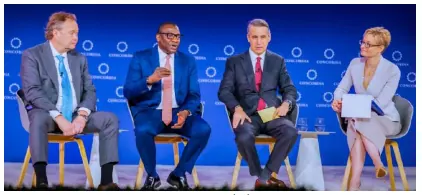
The Chief Executive Officer of World Energy Council Nigeria, Mr. Bala Wunti, has warned that Africa must not repeat the costly economic model under which the continent exported crude oil and imported refined petroleum products with lithium, cobalt, and rare earth elements. Wunti made this statement at the 2026 Concordia Annual Summit in New York during a panel titled, “Rare Currency: Critical Minerals in a Shifting Global Economy.” The summit brought together heads of state, senior government officials, and business leaders from more than 100 countries.
Wunti emphasized that Africa must move beyond serving as a source of raw materials and position itself as a competitive processing and manufacturing partner within the emerging global critical minerals economy. He stressed that the urgency, need, and speed of action are essential in addressing the supply gap, which has become a compelling national priority for the United States. Wunti also highlighted that domestic production takes decades, and allies are indispensable in achieving this goal.
The global economy is moving from an era dominated by hydrocarbons to one in which strategic minerals will shape industrial development and international power. Wunti noted that for the past 50 years, energy was priced in barrels, but for the next 50 years, it will be priced in kilograms, including kilograms of lithium, cobalt, graphite, and rare earth elements. He cautioned that whether those kilograms are controlled by allies or adversaries will help define the next global industrial order.
Wunti cautioned African governments against allowing the continent’s critical minerals to be exported permanently in their raw form. He stated that exporting crude oil and importing refined petroleum products created poverty, not prosperity, and that this model must not be repeated with lithium, cobalt, and rare earth elements. A temporary concentrate export arrangement may be commercially necessary, but the permanent export of raw minerals amounts to colonial economics.
According to Wunti, Africa’s opportunity lies in building processing capacity, attracting investment, and creating employment through local value addition. He emphasized that Africa must not remain merely a source of raw materials but become a processing partner. The African countries that develop projects and enter the market fastest will have an advantage, and the real prize is value addition through processing, factories, employment, and industrialization on the continent.
Wunti identified six requirements for attracting capital into the sector, including reliable geological data, clearly defined projects, enabling infrastructure, predictable regulation, credible developers, and viable routes to market. He also highlighted the Nigerian Solid Minerals Company as the country’s flagship investment platform, established to transform mineral resources into commercially viable projects. The company aims to move Nigeria from simply saying, “We have minerals,” to presenting investable projects with clear commercial propositions.
Wunti welcomed recent measures introduced by the United States, including Executive Order 14241, development finance initiatives, export controls, and bilateral mineral agreements. He emphasized that African governments must respond to such international developments with sound policies and commercial discipline. Ultimately, private capital must do the heavy lifting, but governments must make projects investable by addressing the risks investors cannot solve independently.
Key points
- Africa must not repeat the costly economic model of exporting raw materials and importing refined products with lithium, cobalt, and rare earth elements.
- The continent must move beyond serving as a source of raw materials and position itself as a competitive processing and manufacturing partner within the emerging global critical minerals economy.
- African governments must respond to international developments with sound policies and commercial discipline to make projects investable and attract private capital.