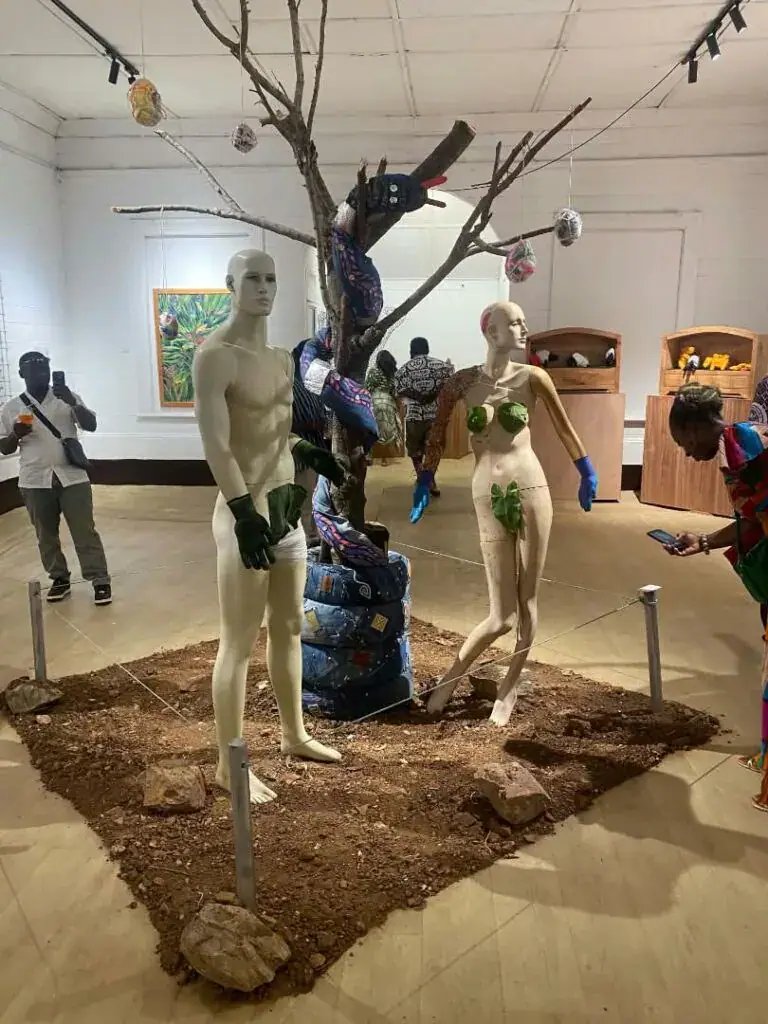
Accra's Kantamanto Market, one of the world's largest destinations for secondhand clothing, faces a significant waste crisis. Ghanaian fashion curator Beatrice "Bee" Arthur has created an installation, JEAN-ESIS: Chapter One, at the Accra Art Centre, to bring attention to this issue. The installation features mannequins draped in salvaged denim, surrounded by used tyres and dried cemetery branches. This artwork is part of a larger exhibition, BEYOND CREATION: Humanity, Nature and Spirituality, a Universal Message.
The installation, which took four weeks to complete, is made almost entirely from materials discarded at Kantamanto Market. Old denim, rubber gloves, textile offcuts, and 20-year-old mannequins were arranged alongside tyres sourced from local vulcanisers and dead tree branches collected from a cemetery. A hand-stitched and hand-painted serpent at the installation's centre represents wisdom, fertility, regeneration, and hope. The mannequins symbolise garment workers in Asian denim factories exposed to hazardous chemicals.
Kantamanto Market receives approximately 15 million garments weekly, with around 40 percent of that volume becoming waste. This waste is often dumped, buried, or washed into drains and onto Accra's beaches. The Or Foundation, a non-profit organisation operating in Kantamanto, provided these estimates. Arthur's installation aims to make viewers confront the scale of Ghana's clothing waste crisis.
The exhibition, BEYOND CREATION: Humanity, Nature and Spirituality, a Universal Message, opened on October 4, 2026, and features 40 artists, about 90 percent of them Ghanaian. The exhibition is a collaboration with the Embassy of Italy and runs until November 4, 2026. Italy's Ambassador to Ghana and Togo, Laura Ranalli, attended the opening, alongside Dr Fio Richardson Commey, Special Aide to the Minister for Tourism, Culture and Creative Arts.
Arthur credited Wakefield Wisdom Ackuaku, Acting Executive Director of the National Commission on Culture, and Eric Ohene-Larbi, Greater Accra Regional Director of the Centre for National Culture, for facilitating the collaboration with the Italian Embassy. The installation has garnered attention from local and international communities, sparking conversations about sustainable practices in the fashion industry.
The use of discarded materials in JEAN-ESIS: Chapter One highlights the potential for creative reuse and recycling. By transforming waste into art, Arthur aims to inspire change and raise awareness about the environmental impact of fast fashion. The installation serves as a powerful reminder of the need for sustainable practices in the fashion industry.
As the exhibition continues, visitors can expect to engage with thought-provoking artworks that challenge perceptions of humanity, nature, and spirituality. JEAN-ESIS: Chapter One is a significant contribution to this conversation, using art to drive home the importance of addressing Ghana's clothing waste crisis.
Key points
- The installation, JEAN-ESIS: Chapter One, is made from materials discarded at Kantamanto Market, highlighting the scale of Ghana's clothing waste crisis.
- Kantamanto Market receives approximately 15 million garments weekly, with around 40 percent becoming waste.
- The exhibition, BEYOND CREATION: Humanity, Nature and Spirituality, a Universal Message, features 40 artists and runs until November 4, 2026.