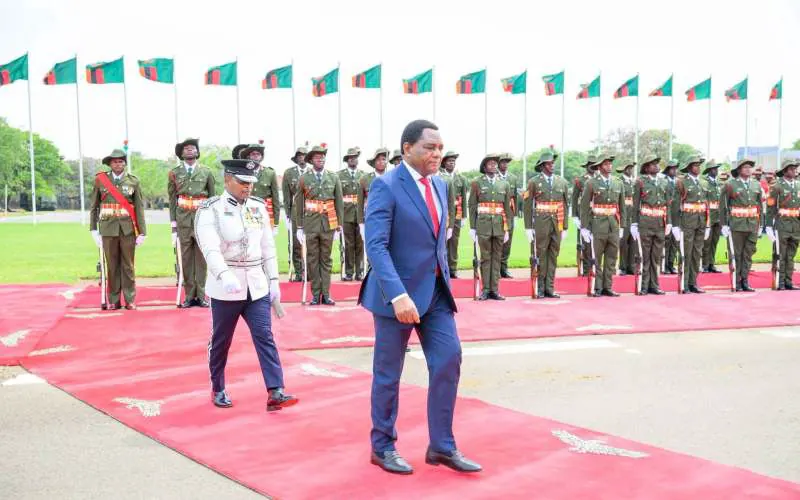
Zambia has identified the Walvis Bay–Ndola–Lubumbashi corridor as a key transport route to accelerate over the next five years, as President Hakainde Hichilema seeks to position the country as a regional transport and logistics hub. This move aims to improve regional connectivity, facilitate trade and investment, and strengthen the movement of goods across borders. The Walvis Bay corridor is crucial for landlocked countries, including Zambia, which relies heavily on Namibia's port infrastructure.
In his address opening Zambia's 14th National Assembly on 9 October 2026, Hichilema outlined the government's priorities, including the development of transport corridors such as the Durban, Walvis Bay–Ndola–Lubumbashi, Lobito, TAZARA, and Nacala routes. The government aims to address delays, corruption, and inefficient processes at border points, which constrain economic growth and undermine investor confidence. To tackle these challenges, Zambia plans to digitize border processes and remove unnecessary administrative barriers.
The Zambian government's plans to develop the Walvis Bay corridor reinforce the port's role in regional transport and logistics networks serving landlocked countries. For Namibia, this emphasis highlights the port's significance in facilitating trade and investment. However, Hichilema's address did not provide project costs, construction timelines, or specific commitments on infrastructure development along the corridor. The corridor is part of a broader transport and economic programme aimed at expanding Zambia's economy, creating jobs, and improving access to regional and international markets.
The Zambian government plans to work with the private sector to construct, rehabilitate, and maintain roads while improving connectivity between provinces, districts, and economic centres. The administration also intends to upgrade airports and accelerate the construction of new airport infrastructure. This multi-faceted approach aims to enhance Zambia's transportation network, making it more efficient and attractive to investors.
Beyond transport, Zambia plans to expand its energy supply and diversify fuel-import routes. Hichilema announced plans to pursue the construction of the Namibia–Zambia refined-petroleum and natural-gas pipelines, alongside proposed pipelines linking Zambia with Angola, Tanzania, and Zimbabwe. These projects aim to reduce Zambia's vulnerability to dependence on a single fuel-supply route while creating jobs, business opportunities, and government revenue.
The proposed pipelines add an energy dimension to Zambia's plans to strengthen economic links with Namibia. Hichilema's wider economic programme targets significant growth in various sectors, including mining, agriculture, livestock, tourism, energy, and manufacturing. The government aims to achieve annual copper production of three million tonnes, electricity-generation capacity of 10,000 megawatts, and five million international tourist arrivals.
To achieve these ambitious targets, the Zambian government recognizes the importance of private-sector investment. The administration plans to create a conducive business environment and facilitate partnerships to drive economic growth. One of the key goals is to earn US$1 billion annually from beef exports, highlighting the potential for growth in the agricultural sector.
Key points
- Zambia targets annual copper production of three million tonnes and electricity-generation capacity of 10,000 megawatts.
- The government aims to earn US$1 billion annually from beef exports.
- The Walvis Bay corridor is crucial for landlocked countries, including Zambia, which relies heavily on Namibia's port infrastructure.