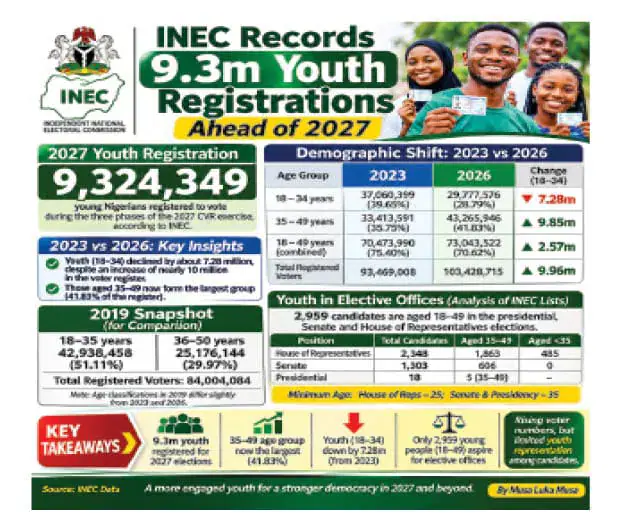
The Independent National Electoral Commission (INEC) has reported that 9,324,349 young Nigerians registered to vote during the recent Continuous Voter Registration (CVR) exercise ahead of the 2027 general elections. This represents a significant portion of the total voter register, which stands at 103,428,715. According to INEC chairman Prof Joash Amupitan, this figure underscores the importance of young Nigerians in the country's democratic process.
An analysis of the demographic composition of the voter register reveals a shift in the age categories of registered voters. Voters aged between 18 and 34 number 29,777,576, representing 28.79% of the total register. In contrast, those aged 35 to 49 constitute the largest category, with 43,265,946 voters, representing 41.83% of the register. This marks a change from the 2023 general elections, when young people aged 18 to 34 constituted the largest demographic group on the voter register.
The figures raise questions about the changing age composition of Nigeria's electorate and the extent to which newly eligible young Nigerians are participating in voter registration and other aspects of the political process. In the 2019 general elections, INEC recorded 42,938,458 voters aged 18 to 35, representing 51.11% of the 84,004,084 registered voters. However, the age classifications used in the 2019 report differ slightly from those of 2023 and 2026, making a direct comparison of the same age groups across the three registration periods difficult.
Despite the significant number of young registered voters, their representation among those seeking elective offices presents another dimension of youth participation in the political process. An analysis of INEC's final lists of candidates for the presidential and National Assembly elections shows that 2,959 candidates fall within the 18 to 49 age bracket. The House of Representatives has the highest number, with 2,348 candidates aged below 50.
The analysis excludes running mates and seven House of Representatives candidates whose ages were incorrectly printed in INEC's lists. It also does not include governorship and State Houses of Assembly candidates. The figures show a difference between young Nigerians' presence as electorates and their representation among candidates seeking national elective offices.
Some civil society organisations (CSOs) and stakeholders have called on INEC to remove barriers discouraging young Nigerians from participating in the 2027 general elections. They identified difficulties in collecting permanent voter cards (PVCs), voter registration challenges, inadequate voter education, declining public confidence, and electoral violence as major obstacles to youth participation.
The Not-Too-Young-To-Run bill, signed into law by President Muhammadu Buhari in 2018, reduced the age qualification for elective offices to enable more youths to participate. While some young Nigerians, such as Ibrahim Mohammed Bello and Omosede Gabriella Igbinedion, have taken advantage of the bill to run for office, the overall representation of young Nigerians in elective offices remains low.
Key points
- Young voters aged 18-34 make up 28.79% of Nigeria's voter register.
- Only 9.3 million young Nigerians registered to vote ahead of the 2027 general elections.
- The House of Representatives has the highest number of candidates aged below 50.
Reporting sources
- 2027: Young voters, old politicians · Daily Trust