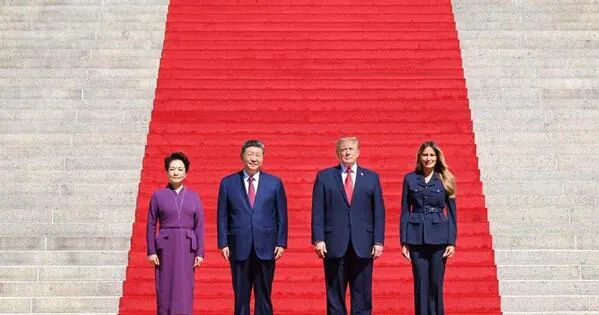
Chinese President Xi Jinping and his wife, Peng Liyuan, visited the U.S. National Archives in Washington on Friday, accompanied by U.S. President Donald Trump and his wife, Melania Trump. The National Archives, established in 1934, houses the Declaration of Independence, the Constitution, and the Bill of Rights. These documents are central to the founding of the United States and essential to understanding its history over more than two centuries. Xi said the archives carry the wisdom of the forebears and offer insights for the future.
During his visit, Xi reflected on the history and culture of China and the United States. He noted that over the past 250 years, the American people have pursued the American Dream and built a prosperous country. In contrast, the Chinese people have continued to make new achievements on the new journey toward realizing the Chinese Dream of the great rejuvenation of the Chinese nation. Xi emphasized that China and the United States have different histories and cultures, social systems, and development paths.
Despite these differences, Xi said that the people of the two countries share the same aspiration for a better life. Peng and Melania also visited the National Museum of Asian Art in Washington, a renowned U.S. institution dedicated to the collection, research, and exhibition of Asian art. The tour to the National Archives and the art museum echoed the special arrangements China made for Trump during his previous trips to Beijing.
During Trump's state visit to China in May, Xi invited him to see the Temple of Heaven, a more than 600-year-old landmark near the southern end of the Beijing Central Axis. Xi explained to Trump that in ancient times, state rituals were held in the temple, where then Chinese rulers prayed for national prosperity, social harmony, and favorable weather for good harvests. Trump described the Temple of Heaven as "great" and "incredible."
Xi has a longstanding commitment to promoting exchanges and mutual learning among different cultures. He once said that for any country in the world, the past always holds the key to the present, and the present is always rooted in the past. Only when we know where a country has come from can we possibly understand why the country is what it is today.
At the state dinner held by Trump in the White House on Thursday, Xi recounted the history of China-U.S. exchanges that stretches back more than 200 years. He announced a series of new initiatives to further boost people-to-people bonds between the two countries, including an invitation for 100,000 young Americans to visit China for exchanges and study in the coming five years.
Xi believes that understanding the differences between China and the United States can create more space for dialogue and coexistence between countries. If the two countries recognize and respect their differences, deepen mutual understanding, and learn from each other, China-U.S. relations will enjoy steady and sustained growth.
Key points
- Chinese President Xi Jinping visits the U.S. National Archives in Washington with U.S. President Donald Trump.
- Xi Jinping and Donald Trump strengthen friendship between China and the United States through cultural exchanges.
- China and the United States agree to boost people-to-people bonds through new initiatives.