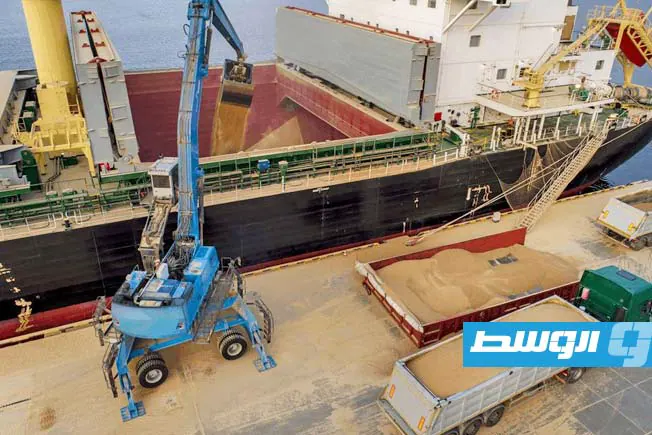
The ongoing conflict in the Eastern Mediterranean has drawn attention away from another critical issue: the blockade of the Black Sea, which is threatening to disrupt global food supplies. According to a report by Bloomberg, Russia and Ukraine account for over a quarter of the world's wheat trade, a share that is comparable in importance to the oil transported through the Strait of Hormuz. The blockade has already caused damage to grain shipments, forcing countries to look for alternative sources.
The attacks on ports in Russia and Ukraine have significantly impacted grain supplies. Since July, the conflict has resulted in damage to grain terminals, silos, and ships. Additionally, energy infrastructure in Russia has been targeted, causing diesel prices to skyrocket to record levels. This increase in costs is putting pressure on agricultural production and food prices. According to estimates by SovEcon, the total Russian and Ukrainian wheat exports during the current harvest season may drop to about half of last year's levels.
Russia and Ukraine also dominate the global trade in sunflower oil, accounting for around two-thirds of the market, and are significant exporters of corn. Their agricultural products are shipped to countries such as Egypt, India, Turkey, and Vietnam. However, Russia is struggling to export its grain due to Ukrainian drone attacks, while Ukraine is facing challenges in transporting its produce through land and river routes. Ukrainian ports on the Black Sea, which typically handle around 90% of the country's grain exports, are under frequent Russian attack.
In response to the potential shortage, countries are seeking alternative sources of grain. Turkey and the UAE are turning to the Baltic states, such as Lithuania, Latvia, and Estonia, for supplies. Bangladesh is looking to Romania and Argentina, as well as limited quantities from India, after New Delhi lifted a years-long ban on wheat exports. Buyers are also turning to Australia, which is expected to start harvesting its crop soon. However, these alternatives may not be enough to make up for the lost supplies from the Black Sea.
Russia is exploring new routes to export its grain, including through Kazakhstan, the Baltic Sea, and the Caspian Sea. The country is also looking to export grain through its eastern regions. During the BRICS summit in India, Russian Agriculture Minister Oksana Lut stated that millions of tons of Russian grain are being shipped through Kazakhstan or the Baltic Sea and Caspian Sea. However, these routes increase transportation costs, which could be a significant burden for Russian grain exports.
Ukraine is facing an even bigger crisis, as agricultural shipments account for more than half of its export earnings. The country is struggling with a grain storage crisis, with warehouses filling up and local prices dropping. Ukrainian farmers are facing significant losses, and the country's grain storage capacity may reach its limit by early November. To address this issue, Ukraine is trying to increase shipments through the Romanian port of Constanta, but low water levels in the Danube River are complicating these efforts.
The blockade of the Black Sea has significant implications for global food supplies, with concerns about a potential food crisis. The world's reliance on Russian and Ukrainian grain exports is higher now than it was during the 2010 Russian grain crisis, which contributed to the Arab Spring protests. With many countries relying on low-cost grain from the Black Sea region to support their bread subsidies, a disruption to supplies could have far-reaching consequences.
Key points
- The Black Sea blockade is threatening global food supplies, with Russia and Ukraine accounting for over a quarter of the world's wheat trade.
- Countries are seeking alternative sources of grain, but these may not be enough to make up for the lost supplies from the Black Sea.
- The blockade has significant implications for global food supplies, with concerns about a potential food crisis.