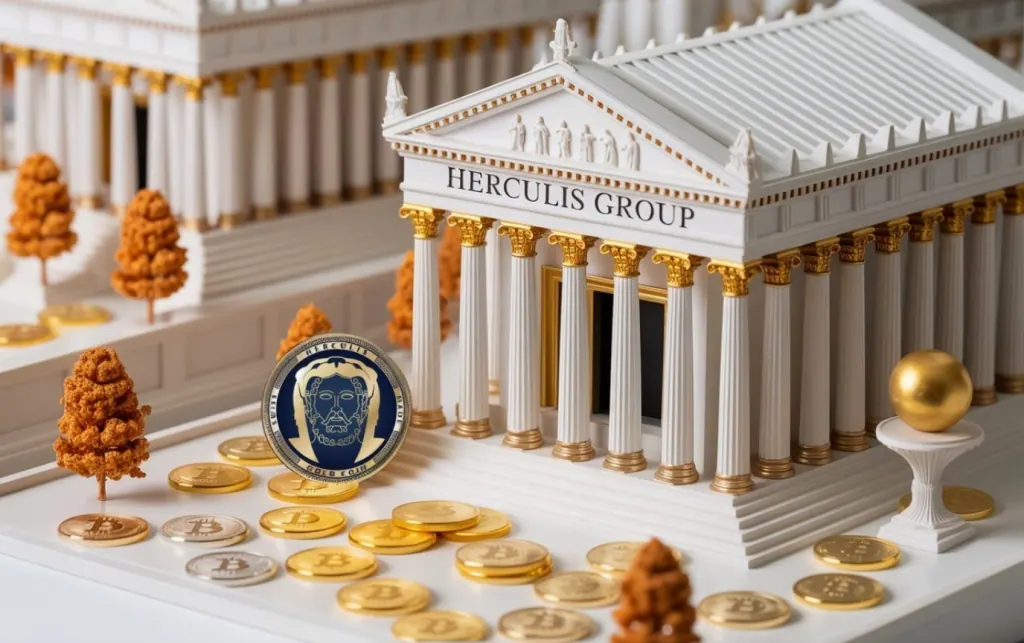
Herculis Group, a Swiss investment boutique, has introduced XAUH, a digital gold token that combines Swiss refining, storage, and verification standards with blockchain settlement. The token has been launched at a time when investors are seeking alternatives to traditional assets amid inflation, public debt, and geopolitical instability. XAUH digital gold allows for fractional, verifiable ownership of gold, making it an attractive option for investors. The token is backed by physical gold stored in vaults and is designed to provide a secure and transparent way to invest in gold.
The gold market has experienced structural scarcity over the past decade, with global production peaking in 2013 at around 3,000 tonnes per year and falling to approximately 2,400 tonnes today. Mining costs have risen by over 20% in the past decade due to factors such as increasing energy costs, environmental regulations, and technical difficulties. As a result, demand for gold has broadened beyond traditional buyers, with central banks in Russia, China, India, and Turkey consistently purchasing gold. Investment demand has also grown through gold-backed exchange-traded funds and cryptocurrency instruments.
XAUH digital gold aims to make investing in gold more accessible and affordable. The token is divisible to a hundredth of a gram, allowing savers to accumulate exposure to gold with a smaller investment. XAUH was initially issued on JAMTON, a Layer 2 network spanning TON and Polkadot, but has since expanded to include Ethereum and TRON, broadening its footprint. This allows XAUH to reach a wider set of wallets, exchanges, and liquidity while remaining cost-effective.
Herculis Tokens SA, the issuer of XAUH, is a part of the Herculis Group, which has over 15 years of experience in serving wealthy clients through various entities. The group set up a dedicated asset-tokenization division in 2024 and began working with the JAMTON.NETWORK team later that year. The first tokens were issued in 2025, backed by approximately 3.5 kilograms of gold. This lineage provides credibility to XAUH, as it is backed by a bullion house that has moved into blockchain technology.
The mechanics of XAUH are straightforward, with each token minted only when a matching gram of bullion enters the vaults. The supply of XAUH is uncapped but fully collateralized, expanding as reserves grow and contracting as holders redeem. Customers can buy as little as 0.01 grams of gold, equivalent to about $1, and convert existing LBMA bullion into XAUH for a 0.3% fee. Transfers cost 0.02%, making XAUH a cost-effective option for investing in gold.
As of September 2026, the circulating and total supply of XAUH was reported to be 15,500 by CoinGecko and CoinMarketCap. However, readers are advised to confirm current figures directly with these cryptocurrency data services, as the numbers may change over time. The tokenization of real-world assets, including gold, has become a mainstream institutional strategy, with firms like BlackRock and JPMorgan beginning to tokenize securities and deposit products.
XAUH reflects this shift towards tokenization, combining the stability of physical bullion with the advantages of blockchain technology. As a gold-backed cryptocurrency, XAUH provides continuous access to gold, allowing it to trade around the clock on supporting exchanges. This contrasts with traditional gold-backed exchange-traded funds and futures, which are subject to regional business hours and settlement delays.
Key points
- Herculis Group's XAUH digital gold token combines Swiss refining and blockchain settlement.
- The gold market has experienced structural scarcity, driving demand for alternative investment options.
- XAUH aims to make investing in gold more accessible and affordable through its divisibility and low costs.