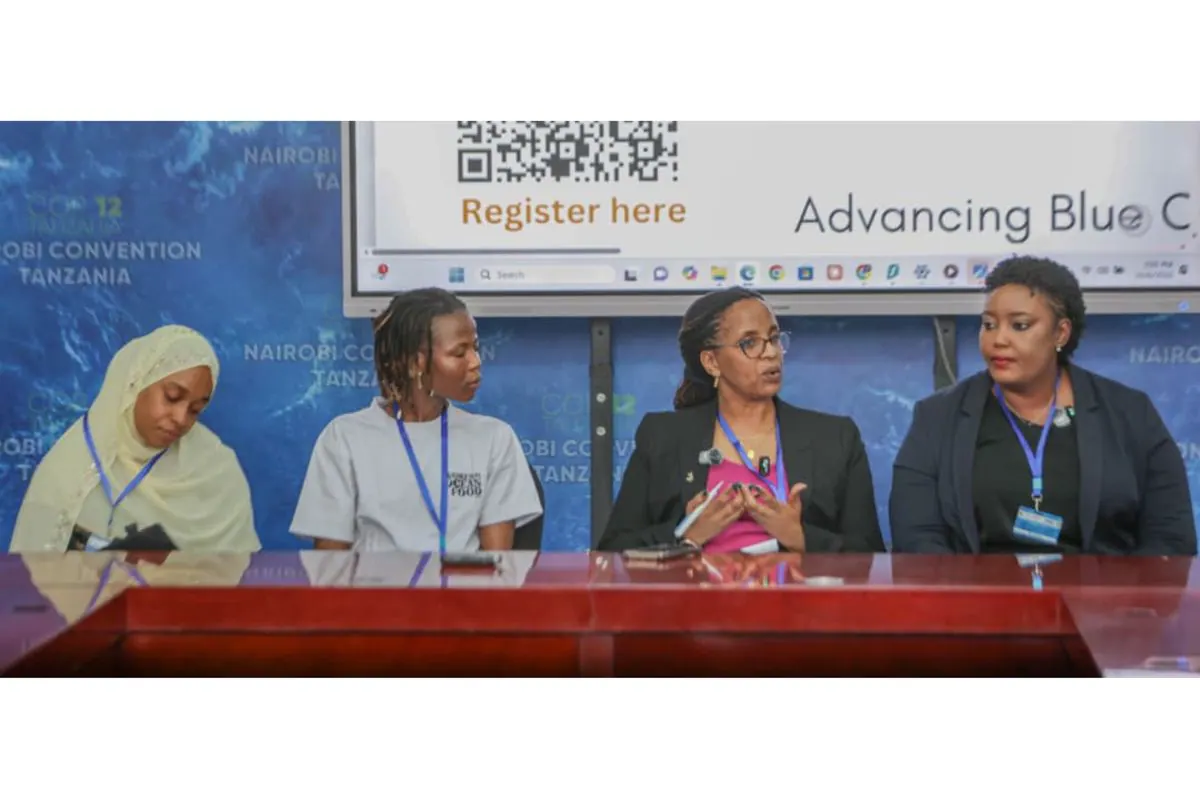
Stakeholders attending a side event at the 12th Conference of Parties (COP12) to the Nairobi Convention in Dar es Salaam have urged for women to take on more significant roles in the blue economy. They emphasized that women's participation requires more than just representation in programmes, but also deliberate efforts to build their business skills, improve access to finance and investment, and prepare them for leadership positions. This call was made during an event organized by the Women's Fund Tanzania Trust (WFTT), focusing on women's participation in blue carbon conservation, climate resilience, and the blue economy.
The event, held on the sidelines of COP12, brought together various stakeholders to discuss the importance of women's participation in the blue economy. WFTT executive director Rose Marandu highlighted the need for women and coastal communities to access resources, knowledge, and financing to develop solutions to the challenges they face. She mentioned that WFTT has been implementing the ReSea project to conserve marine environments and promote the blue economy in different regions, including Zanzibar.
Environmental specialist and Community Manager for Africa at Hatch Blue, Shamim Wasii Nyanda, emphasized that women should be viewed as owners and leaders of businesses capable of attracting investment, rather than just beneficiaries of programmes. She noted that many women in the sector remain concentrated in lower-level leadership positions and that support should include helping women prepare investment proposals, communicate the value of their businesses to investors, and demonstrate their potential to generate revenue.
Nyanda also stressed the importance of women working together rather than competing for limited opportunities. She called for programmes that help women start and expand businesses, increase revenues, and become investment-ready. According to Nyanda, women-led businesses need space to grow and contribute to the economy.
The Government of Tanzania has expressed its commitment to working with the private sector, civil society, and development partners to strengthen environmental management, climate action, and gender equality. Evancia Shirima from the Vice President's Office stated that the Government is pursuing measures to reduce greenhouse gas emissions across economic sectors while encouraging stakeholders to develop programmes with measurable results.
Despite the efforts to promote women's participation in the blue economy, social attitudes remain a barrier. Ziyana Masoud, a blue economy entrepreneur from Pemba, shared her experience of overcoming the perception that women cannot succeed in business. She is now the chairperson of an entrepreneurship group engaged in sea cucumber farming, earning income, and looking for more opportunities.
Stakeholders believe that strengthening women's participation in the blue economy will not only advance gender equality but also unlock their contribution to sustainable marine conservation, blue carbon, and the wider blue economy in Tanzania and the Western Indian Ocean region. The call for greater support and empowerment of women in the blue economy is expected to have a positive impact on the sector.
Key points
- Women should be supported to move beyond being beneficiaries of climate and blue economy programmes and become business owners, investors, and decision-makers.
- Deliberate efforts are needed to build women's business skills, improve access to finance and investment, and prepare them for leadership positions.
- Strengthening women's participation in the blue economy will advance gender equality and unlock their contribution to sustainable marine conservation and the wider blue economy.