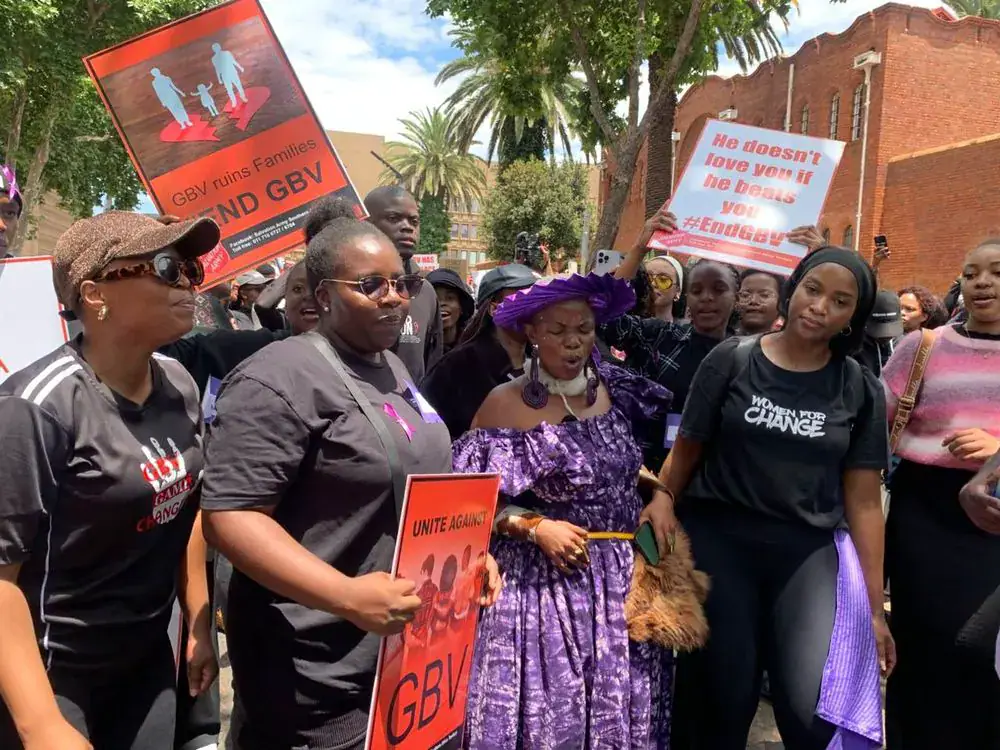
On November 21, demonstrators marched to Constitution Hill in Johannesburg, chanting and singing in solidarity with victims and survivors of gender-based violence and femicide (GBVF). The march, which started at Wits University, was part of the Women's Shutdown organised by Women For Change. The group has given the government 30 days to respond to their demands for accountability. Demonstrators wore black and purple, showing their support for the cause.
The demonstration was a follow-up to last year's shutdown, where thousands of South Africans participated in calling for GBVF to be declared a National Disaster. GBVF was classified as a national disaster in November 2025, marking a significant moment in the country's fight against GBVF. However, some demonstrators felt that the government had not taken sufficient action since then. They wanted answers about the implementation of previous promises, particularly regarding the National Register for Sex Offenders (NRSO).
Senty Maphosa, a 28-year-old demonstrator, said she had returned to Constitution Hill hoping to receive feedback on the commitments made during last year's demonstration. She wanted to hear about the progress made on the NRSO and what action was being taken against perpetrators. The Department of Justice and Constitutional Development describes the NRSO as a confidential register containing details of people convicted of sexual offences against vulnerable persons.
However, Maphosa expressed disappointment with the lack of clear evidence of implementation. She felt that the government was repeatedly making assurances without taking concrete action. "I think coming in today, I wanted to get feedback from last year, because I was here last year, wanting to hear about the NRSO, what exactly is going to happen, what actions are they going to take against perpetrators," she said.
Women For Change's Operations and Advocacy Manager, Merlize Jogiat, said the organisation had not initially planned to host another shutdown this year. However, the continued scale of GBVF and the lack of sufficient political urgency had made further mobilisation necessary. "Look, we were not planning to have it again this year but it is clear that gender-based violence is not as important to our politicians as elections," Jogiat said.
Minister in the Presidency responsible for Women, Youth and Persons with Disabilities, Sindisiwe Chikunga, defended the government's response, saying several interventions were already underway. She pointed to the opening of additional Thuthuzela Care Centres and sexual offences courts, as well as work being undertaken with the police through the National Joint Operational and Intelligence Structure (NATJOINTS).
Chikunga outlined the government's implementation of the National Strategic Plan on GBVF (NSP-GBVF), which provides the framework for its response across prevention, justice, safety, protection and survivor support. She acknowledged that the sexual offences case backlog was worsening and that evidence on case progression and survivors' experiences remained uneven. The government has 30 days to respond to Women For Change's demands.
Key points
- Women For Change demands tangible action against GBVF from the South African government.
- The organisation has given the government 30 days to respond to their demands.
- Demonstrators express frustration over repeated assurances without clear evidence of implementation.