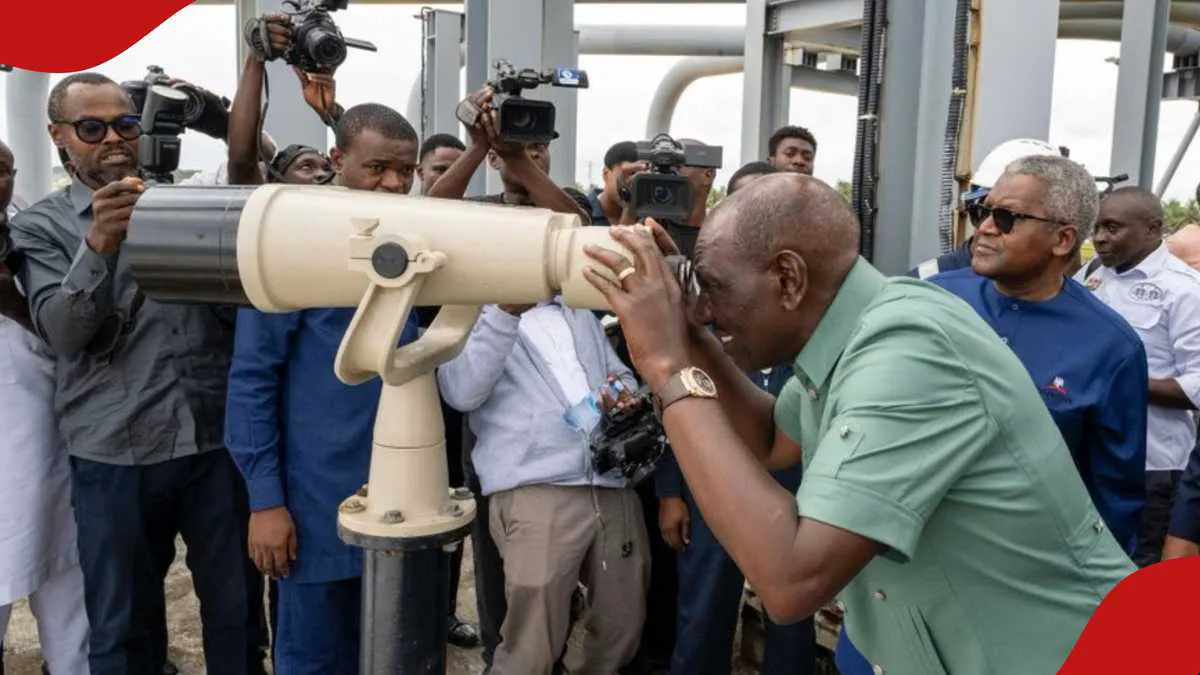
On September 25, 2026, Kenyan President William Ruto visited the Dangote Refinery in Lekki, Lagos State, Nigeria, at the invitation of Aliko Dangote, Africa's richest man. The refinery, one of the largest in the world, has a crude oil refining capacity of 700,000 barrels per day and produces over 100 million litres of fuel daily. Ruto's visit comes ahead of a groundbreaking ceremony for the Dangote East African Refinery in Lamu, Kenya, scheduled for the following week.
The Dangote Refinery in Nigeria has been in operation for years, recently reaching full capacity and significantly impacting the country's fuel import dynamics. The facility's construction included a notable engineering feat: 120 kilometres of undersea pipelines to transport crude oil directly from ships to the plant. This project showcases the potential for large-scale industrial development in Africa, with Ruto highlighting it as an example of what can be achieved through collaboration between governments, investors, and financial institutions.
During his visit, Ruto expressed his admiration for the refinery, describing it as a powerful example of African potential. He shared his impressions on social media, emphasizing the importance of cooperation in achieving such significant projects. The Kenyan president's tour and upcoming Lamu refinery project have generated considerable interest, both locally and internationally, with many seeing it as a transformative energy project for East Africa.
The planned Lamu refinery in Kenya could have far-reaching implications for the region, potentially reducing dependence on imported refined fuel products. If the project mirrors the scale of the Nigerian operation, it would mark a significant shift in Kenya's energy landscape. Aliko Dangote, a champion of African industrialization, has long been involved in large-scale projects, and his investment in Kenya could have a substantial impact on the country's economy.
Reactions to Ruto's visit and the Dangote Refinery have been overwhelmingly positive, with many celebrating the Pan-African spirit behind the investment. Social media users have praised Dangote's achievements, with some expressing support for Ruto's efforts to attract similar investments to Kenya. However, not all comments have been favourable, with a few critics questioning the intentions behind such large-scale projects.
The Dangote Group's investment in Nigeria has reshaped the country's fuel import dynamics, and a similar project in Kenya could have a comparable impact. With the Lamu refinery project set to create 60,000 jobs, according to Ruto, it is clear that this initiative has the potential to drive economic growth and development in the region. As Africa continues to explore its industrialization potential, projects like the Dangote Refinery and the planned Lamu refinery will be closely watched.
As Kenya prepares for the groundbreaking ceremony of the Dangote East African Refinery, the country is eagerly anticipating the potential benefits of this project. With President Ruto's visit to the Nigerian refinery, the stage has been set for a new era of cooperation and investment between Kenya and Nigeria. The success of such projects will depend on continued collaboration between governments, investors, and financial institutions, but the prospects for growth and development are undeniable.
Key points
- President William Ruto visited the Dangote Refinery in Nigeria, highlighting its potential as a model for African industrialization.
- The Dangote Refinery has a crude oil refining capacity of 700,000 barrels per day and produces over 100 million litres of fuel daily.
- A similar refinery project is planned for Lamu, Kenya, which could create 60,000 jobs and significantly impact the region's energy landscape.