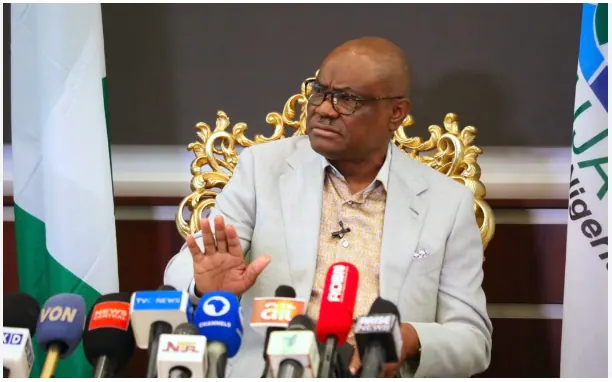
Nigerian politician Nyesom Wike has never been one to hide behind ambiguity, taking loud and visible stances on politics. His latest confrontation with governors elected on the All Progressives Congress (APC) platform has generated significant attention. The dispute is not just about a coalition, but a contest over political influence, party structures, and who controls the machinery around President Bola Ahmed Tinubu as Nigeria approaches the 2027 elections.
The APC Governors' Forum recently rejected political alliances that could create parallel structures or undermine APC candidates. In response, Wike stated that he never approached them for an alliance and that his Rainbow Coalition aims to mobilize support for Tinubu's re-election, separate from the APC. Wike's position is that he supports Tinubu for president but has not promised that the PDP will withdraw from other elections.
Wike argues that Nigerian voters have always been capable of voting differently for different offices on the same ballot, citing the 2023 elections as evidence. This logic is behind the Rainbow Coalition, but APC governors see the matter differently. They believe an election is not divisible so neatly and that a coalition supporting Tinubu while opposing APC candidates at other levels could weaken the APC's political machinery.
The governors' concern is not that Wike supports Tinubu, but that he wants to mobilize support outside the formal APC structure while retaining the freedom to support opposing candidates. This is where the political collision begins. The G5, a group formed by Wike and other PDP governors in 2022, was a prototype of this approach. The G5 demanded the resignation of the PDP national chairman and refused to support the PDP's presidential candidate.
Wike eventually became closely associated with Tinubu's presidential campaign in Rivers State, while other G5 members made different choices. The important lesson from the G5 was that party membership did not necessarily determine presidential loyalty. The Rainbow Coalition appears to be an expanded version of this philosophy, with Wike attempting to construct a broader, cross-party network around Tinubu.
Wike says he wants Tinubu re-elected and has repeatedly described his support as unequivocal. He claims to be mobilizing politicians from different parties for this purpose. In August, he spoke of a "larger Rainbow Coalition" emerging around Tinubu. However, what happens beyond the immediate election is unclear, with speculation about Wike's future political ambitions.
Wike's political calculation appears to involve preserving relevance after 2027, regardless of his position. He argues that relevance does not depend on holding public office, but on how a politician relates to their people and is regarded by them. This statement should not be interpreted as evidence of specific future presidential ambitions, but nor should it be ruled out.
Key points
- Wike's Rainbow Coalition challenges traditional party politics in Nigeria.
- The coalition sparks controversy with APC governors.
- Wike's goals beyond the immediate election are unclear.