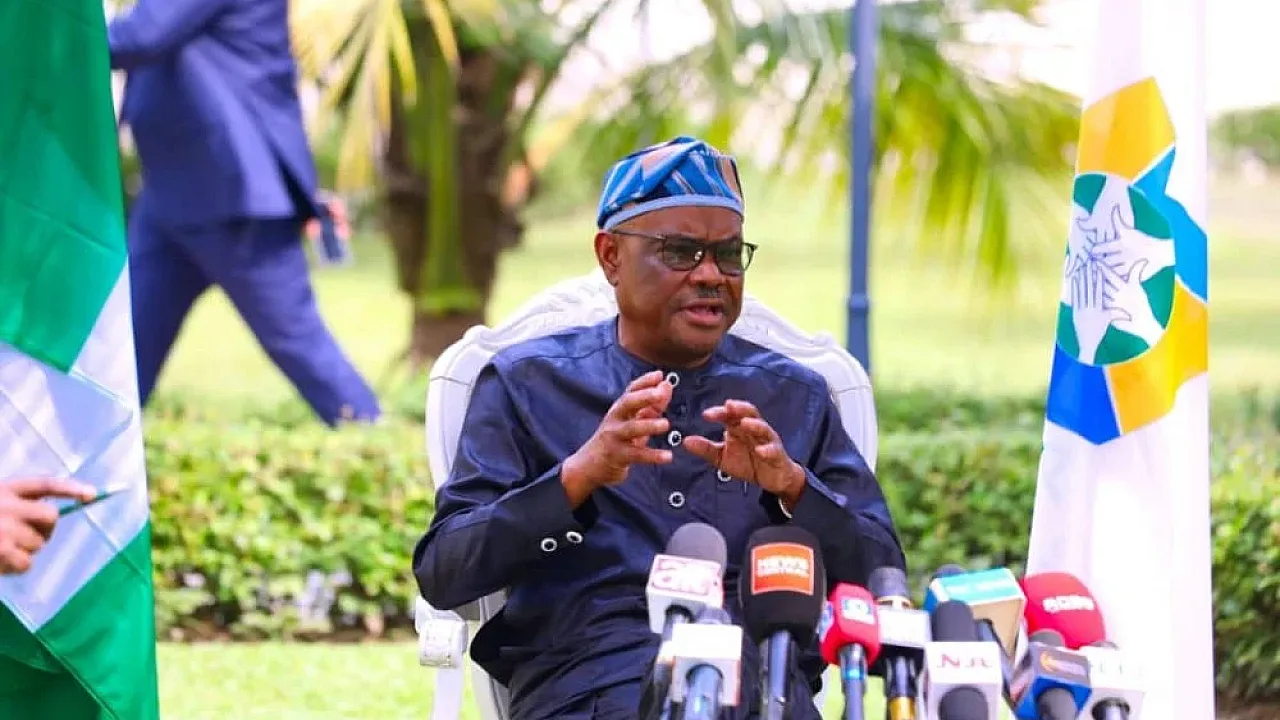
Nigeria's Minister of the Federal Capital Territory (FCT), Nyesom Wike, has denied allegations that he manipulated the 2023 presidential election in the South-South region to favour President Bola Tinubu over Labour Party candidate Peter Obi. Wike made these statements in Abuja while speaking with journalists. He described the claims as "baseless narratives" primarily spread on social media. The allegations surfaced after Wike's appearance on TVC's Journalists' Hangout.
The controversy stems from Wike's comments about the G5 group of Peoples Democratic Party (PDP) governors' strategy during the 2023 election. Wike disclosed that the group aimed to prevent PDP's presidential candidate, Atiku Abubakar, from benefiting from the party's traditional strength in the South-South. The strategy involved allowing Obi to secure votes in some parts of the region rather than allowing Atiku to benefit from the PDP's dominance. Wike emphasized that this strategy should not be interpreted as evidence of personal involvement in rigging the election.
Wike questioned the logic behind the allegations, asking how he could have manipulated the election results. He cited the complex process of collating and submitting results to the Independent National Electoral Commission (INEC). Wike also dismissed the idea that election results could be determined based on limited polling-unit data often discussed on social media. He noted that with about 176,000 polling units, conclusions drawn from just 300 polling units were unfounded.
The FCT minister further argued that allegations of electoral manipulation should have been backed by evidence during the legal challenges that followed the 2023 presidential election. He recalled that during the tribunal proceedings, no one tendered any results from Rivers State to support claims of electoral manipulation. Wike's comments come amid ongoing debates about the transparency and credibility of the 2023 presidential election.
Wike explained the G5's calculations, stating that the group considered Atiku a greater political threat due to the PDP's established support base across the South-South. The group adopted a strategy to ensure Obi won in some areas to deny Atiku votes. This approach was implemented in parts of Edo and Cross River states, while Rivers State was treated differently due to concerns about the implications of an Obi victory there.
Wike distinguished between Obi's popularity on social media and his ability to determine the outcome of a presidential election. He argued that Obi's social media presence did not translate to grassroots support, which is necessary for securing votes. Wike maintained that genuine grassroots support was essential for any candidate to secure votes and that election manipulation could not create support where none existed.
Wike concluded that the G5 had pursued a deliberate political strategy during the 2023 election and remained satisfied with its outcome. He stated that their strategy worked well for them and reiterated that allegations of rigging were unfounded. Wike's statements aim to clarify the G5's actions during the election and address concerns about the credibility of the electoral process.
Key points
- Wike denies allegations of manipulating the 2023 presidential election in the South-South to favour President Bola Tinubu.
- The allegations stem from Wike's comments about the G5 group of PDP governors' strategy during the 2023 election.
- Wike argues that genuine grassroots support is necessary for any candidate to secure votes, and election manipulation cannot create support where none exists.