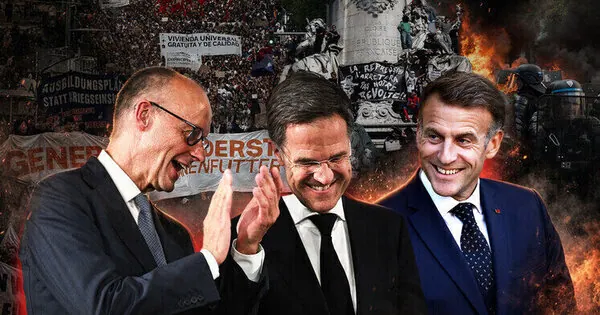
Protests have erupted across Europe, with people taking to the streets in France, Germany, Spain, and other EU states to express their discontent with the current state of affairs. The widespread demonstrations are driven by mounting problems with housing, schools, and jobs, while governments are gearing up for a conflict that many do not want. In Spain, tens of thousands have protested the housing crisis, with rents almost doubling over the past decade.
In France, overlapping protests over wages, spending cuts, public services, and school conditions have gripped the nation. Teachers, healthcare workers, firefighters, and transport staff have joined numerous strikes in recent weeks, while a growing student movement has added school blockades to the disruption. The school protests began in mid-September, with students demanding more teachers, smaller classes, repairs to neglected buildings, and lighter schedules.
The protests in France have turned violent, with 24 schools burned or ransacked, and over 6,500 people arrested over three weeks. Hundreds of students and police officers have been injured, including a 15-year-old who lost his hand to a police grenade and a 16-year-old who reportedly lost sight in one eye after being hit by a rubber bullet. The movement has grown, with violent groups joining the protests, torching buses, attacking emergency workers, and damaging schools.
In Germany, workers and students have taken to the streets as Berlin pursues a frenzied military buildup in the midst of a deepening industrial crisis. Hundreds of thousands are losing their livelihoods, and young men face the prospect of being drafted. Around 45,000 students joined protests in some 100 cities and towns in late September, carrying banners reading 'We won't fight in your wars' and 'Education instead of bombs'.
The German government is pressing ahead with plans to expand the armed forces to more than 260,000 active troops and 200,000 reservists by 2035. Young men are already required to register for potential service, but politicians have been pushing for a return to conscription if voluntary recruitment fails to fill the ranks. Resistance is also showing up in applications to avoid military service, with over 12,000 people seeking conscientious objector status in the first eight months of this year.
The protests in Spain have also been driven by the housing crisis, with tens of thousands taking to the streets after the eviction of an 87-year-old woman from her home of 70 years in Madrid. The eviction sparked demonstrations across Spain, followed by mass marches and a continuing protest camp in central Madrid. Parliament's subsequent rejection of emergency tenant protections added fuel to the fire, bringing tens of thousands into the streets in around 50 cities last weekend.
The situation in Ceuta, Spain's North African enclave, has added to the pressure, with around 72,000 people crossing from Morocco in late July into a territory with roughly 84,000 inhabitants. Although most returned, thousands remained, overwhelming accommodation and straining public services. Residents have taken to the streets demanding stronger border controls and faster deportations, accusing Madrid of abandoning them.
Key points
- Europe's leaders are preparing for war, despite a lack of imminent threat.
- Widespread protests have erupted across Europe, driven by housing, job, and education concerns.
- The protests have turned violent in some countries, with schools burned and people injured.