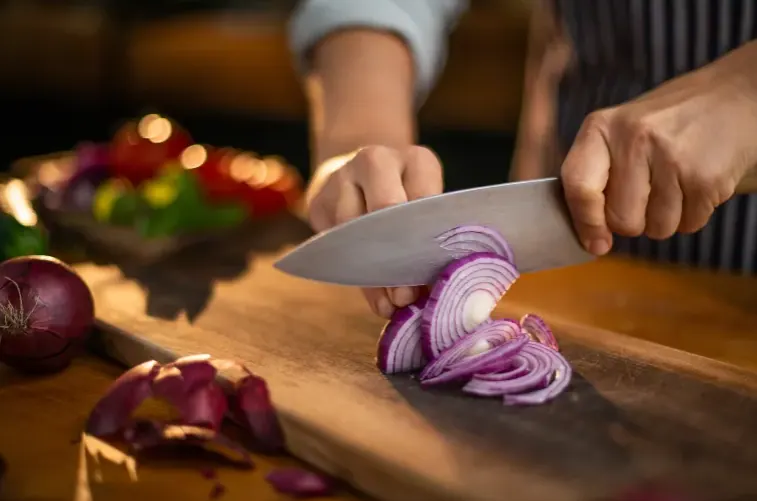
When chopping onions, a gas is released that irritates the eyes, reacting with the moisture in our eyes to form a mild sulfuric acid, stimulating the glands to release more tears. A 2025 study used high-speed cameras to observe what happens during onion chopping. The researchers found that dull knives or violent chopping lead to more droplets and particles in the air, increasing eye irritation and tear production.
The gas released when onions are cut comes into contact with the tear film covering the cornea, and the sensitive nerve endings detect it as an irritant. The nerves then send signals to the lacrimal gland to produce more tears to flush out the irritant and remove it from the eye surface. These tears are called reflex tears, not emotional tears. The release of this gas is part of the onion's defense mechanism against insects and animals that might feed on it.
Onions contain compounds and enzymes that remain separated when the onion is intact. However, when it's cut or crushed, the cells break, and these substances mix, producing a volatile gas called syn-propanethial-S-oxide, responsible for eye irritation and tear production. This mechanism is believed to have evolved as a chemical defense to protect the onion.
Before tears appear, many people experience a stinging or burning sensation in their eyes. This is because the released gas irritates the pain receptors in the eyes, causing symptoms like burning, redness, increased blinking, and tearing. The severity of these symptoms varies from person to person, depending on eye sensitivity, onion type, and chopping method.
The tears produced in response to onion chopping are part of the eye's natural protection system, helping to wash away chemical irritants, moisturize the eye surface, remove fine particles and dust, and protect the cornea from temporary damage. However, these tears do not treat eye diseases or improve vision; they are simply a natural protective response.
Several factors influence the amount of tears produced when chopping onions, including onion type, knife sharpness, and eye sensitivity. Onions with higher sulfur content, like yellow, white, and red onions, tend to cause more tearing. Dull knives can tear onion cells more, releasing more irritating substances. People with dry eyes or allergies may experience more severe symptoms.
To reduce tearing when chopping onions, several methods can be employed: chilling or freezing the onion before cutting, cutting under running water or in a bowl of water, ensuring good ventilation, wearing protective glasses, lighting a candle, or placing a piece of bread soaked in vinegar near the cutting board. These techniques can help minimize the release of irritating gas or prevent it from reaching the eyes.
Key points
- Onion type, knife sharpness, and eye sensitivity affect tear production.
- The gas released by onions is part of their defense mechanism.
- Tears produced in response to onions help protect the eyes but do not treat eye diseases.