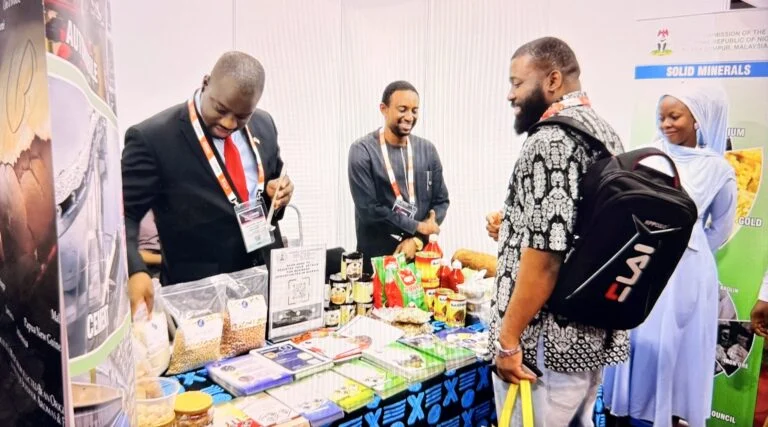
Nigerian products with strong production potential are struggling to achieve sustained access to global markets. The country has an abundance of raw materials, including sesame, hibiscus, shea butter, yam, and cassava, which are in demand beyond its borders. However, a persistent question remains: why do Nigerian products face challenges in accessing international markets? This issue was discussed at the Malaysia International Halal Showcase, MIHAS 2026, by government officials, diplomats, exporters, entrepreneurs, and business operators.
The challenge is not simply a lack of products, but rather the systems required to make those products acceptable, competitive, and sustainable in international markets. A chain of processes, including certification, quality control, processing, packaging, financing, regulation, logistics, market intelligence, and business relationships, must be in place for a product to be successful in global markets. Where this chain is weak, a product may have demand and still fail to become a successful export. For instance, Alh. Magaji Kamal, Chief Executive Officer of Silkim Group and Vice President of Nigerian Entrepreneurs in Malaysia, recalled an attempt to export cassava flour processed in Kano to Mauritius, which was not accepted due to contamination.
The experience of exporting cassava flour to Mauritius highlights the need for Nigerian processing facilities to meet the hygiene and quality requirements of destination markets before products are exported. Kamal noted that some companies have already started to improve their facilities, but many are left behind. Nigerian commodities, including hibiscus flower, sesame, and crayfish, are already finding their way into the Malaysian market, but largely through diaspora demand. However, moving from diaspora consumption to mainstream international consumption requires businesses to understand foreign consumers, regulations, certification, and distribution systems.
Many Nigerian entrepreneurs operating in Malaysia face challenges due to a lack of knowledge about the country's formal business environment. Some continue to rely on informal practices, including operating without proper registration or offices, avoiding tax obligations, and conducting transactions outside formal regulatory structures. Kamal emphasized that once businesses operate by the book, there is a lot of support that the government can provide. The Nigerian Entrepreneurs in Malaysia was established to provide information on registration, taxation, licensing, halal certification, and other requirements for operating in the country.
Certification represents another major barrier for Nigerian exporters. Ali Saidu, Chief Executive Officer of Salid Agricultural Nigeria Ltd., noted that international buyers of Nigerian shea butter require halal certification before purchasing the product. He argued that Nigeria should recognize the halal economy as an international trade opportunity and a potential channel for expanding non-oil exports. Saidu also noted that Nigerian businesses sometimes have to seek certification through countries such as South Africa and Kenya, which can result in lost business opportunities.
The absence of accessible and internationally recognized certification systems in Nigeria can hinder exporters' ability to efficiently obtain the certifications required by buyers. Mrs. Isioma Ona, Managing Director of Ecoepicure Ltd, said Malaysian consumers and African communities in Malaysia have shown interest in Nigerian products, including shea butter, bitter kola, and yam. However, she stressed that Nigerian exporters need to understand Malaysian certification and import requirements to access the market.
The opportunity for Nigerian products to access global markets extends beyond exporting finished products. Mr. Noah Ibitoye, Chief Executive Officer of ZyNooh Store Nigeria, expressed interest in encouraging Malaysian companies to establish manufacturing operations in Nigeria, which could create opportunities for technology transfer, local production, and greater use of Nigerian raw materials. This could help Nigeria move beyond an import-dependent relationship and capture more value locally before products enter international markets.
Key points
- - Nigerian products face challenges in accessing global markets due to issues with certification, quality control, and logistics. - The absence of accessible and internationally recognized certification systems in Nigeria can hinder exporters' ability to efficiently obtain the certifications required by buyers. - Nigerian entrepreneurs operating in Malaysia face challenges due to a lack of knowledge about the country's formal business environment.