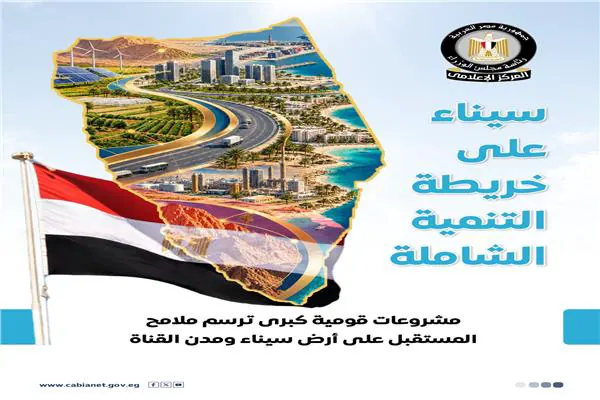
The Egyptian government has made substantial progress in developing the Sinai Peninsula and Canal cities since 2014. According to the Information Center of the Council of Ministers, the government has invested heavily in various sectors, aiming to integrate the region into the country's overall development plan. This effort includes infrastructure development, urban planning, economic growth, and improved public services. The goal is to enhance living standards for residents and promote stability in the region.
A key aspect of this development plan is connecting Sinai to a comprehensive transportation and logistics network. The government has constructed and upgraded 5,000 kilometers of roads and bridges, built five tunnels under the Suez Canal to link Sinai to Canal cities, and established seven floating bridges for crossing the canal. Additionally, work is underway on the first line of the high-speed electric train connecting Ain Sukhna, El Alamein, and Marsa Matruh, spanning 660 kilometers.
The government has also focused on urban development and improving public services. Seven new cities have been built, with a planned population capacity of over five million people. Nearly 58,000 housing units have been constructed, and work is ongoing on four Bedouin communities with 6,053 homes. Furthermore, 18 residential communities are being developed in North and South Sinai, comprising 1,180 homes. These efforts aim to provide better living conditions and services for residents.
Significant investments have been made in water and sanitation infrastructure. A total of 163 projects have been completed, including water supply networks, sewage systems, and treatment plants. As a result, the coverage of drinking water has increased to 96.5% in 2026, up from 84.4% in 2014. Similarly, sewage network coverage has risen to 78% in 2026, compared to 17.3% in 2014. These improvements have significantly enhanced public health and hygiene in the region.
The energy sector has also seen substantial growth. Over 1.6 million households have been connected to the electricity grid as of June 2026. Notable projects include the El Shabab power plant with a capacity of 1,500 megawatts and the Ain Sukhna power plant with a capacity of 1,300 megawatts. Additionally, the government has expanded natural gas services, connecting 300,000 housing units and 1,500 kilometers of gas networks.
The agricultural and fisheries sectors have experienced considerable development. The area of reclaimed and cultivated land has increased by 176.7%, reaching 285,000 feddans in September 2026, up from 103,000 feddans in June 2014. The total area of the Sinai development project has reached 1.1 million feddans, with 18 agricultural communities established. Moreover, investments have been made in irrigation projects, including the Bahr El-Baqr and El-Mahasma drains.
The government has also prioritized education and healthcare. Over 2.5 million citizens have registered for the comprehensive health insurance system, which includes 35 hospitals and 139 medical centers. More than 78 million medical services have been provided. In education, the number of schools has increased by 25.1% to 3,165, and the number of classrooms has risen by 27.9% to 26,600. Investments in higher education have reached 25.6 billion Egyptian pounds, with the establishment of new universities and technological institutes.
Key points
- The Egyptian government has invested heavily in infrastructure development in Sinai and Canal cities since 2014.
- The development plan aims to integrate the region into the country's overall development plan and promote stability.
- Significant investments have been made in various sectors, including transportation, urban development, energy, and education.