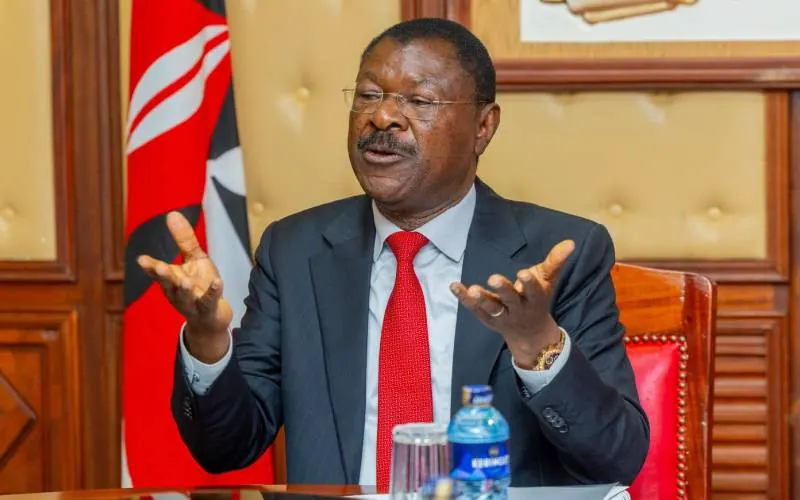
National Assembly Speaker Moses Wetang'ula has called for Africa to strengthen its response to climate change by holding environmental polluters accountable and developing home-grown financing mechanisms for climate action. He made the call while hosting a delegation from the Pan-African Parliament at Parliament Buildings in Nairobi. The discussions focused on the continent's worsening climate crisis and efforts to develop a Model Law on Climate Change for Africa. Wetang'ula emphasized the need for a common legal and policy framework to address environmental degradation.
Wetang'ula stressed that legislation without resources for implementation would have limited impact. He welcomed the initiative for a Model Law on Climate Change, arguing that African countries needed a unified approach to environmental protection and natural resource management. The Speaker proposed that African countries consider taxing the extraction of minerals and other natural resources, with part of the proceeds channelled towards environmental protection, climate adaptation and mitigation. This, he believes, would ensure that climate interventions are backed by sustainable financing.
The Speaker painted a picture of a continent where changing weather patterns are already disrupting livelihoods and traditional knowledge. He cited examples of altered planting seasons and drying water sources, with many streams that were once permanent becoming seasonal. Wetang'ula noted that 90 percent of Kenya's streams are now seasonal, drying up for more than four months a year. He pointed to Kenya's tree-growing programme and efforts to rehabilitate rivers, including the Nairobi River, as examples of climate interventions that require sustained investment.
Wetang'ula also highlighted Kenya's hosting of the United Nations Environment Programme as an opportunity for the country to champion stronger continental environmental action. He called for the establishment of dedicated climate financing mechanisms, including a Climate Change Fund. The Speaker urged the continent to collectively protect its natural wealth for present and future generations, rather than leaving it to individual countries to decide.
The call for stronger accountability was echoed by the Pan-African Parliament delegation. PAP Vice-Chairperson of the Committee on Agriculture, Euphreme Outata, said Africa was bearing a disproportionate burden from climate change and needed stronger financing mechanisms to respond. Outata proposed that revenues generated from mineral extraction be ring-fenced for climate interventions, ensuring that communities benefit directly from the exploitation of natural resources.
Outata said the proposed model law had undergone scrutiny to determine whether it could operate effectively across different African institutions and countries. He urged African governments to ensure climate policies protect vulnerable groups, including women, children, persons with disabilities and fishing communities, who often face heightened exposure to environmental and economic disruptions. The push comes against the backdrop of growing pressure on African countries to balance economic development with environmental protection.
The discussions between Wetang'ula and the Pan-African Parliament delegation reflect the growing concern about climate change in Africa. With the continent holding vast mineral, energy and natural resources, many countries remain financially constrained in their ability to fund adaptation and mitigation. The proposed Model Law on Climate Change aims to address these challenges and ensure that Africa is better equipped to respond to the climate crisis.
Key points
- Africa needs to develop home-grown financing mechanisms for climate action.
- The continent requires a common legal and policy framework to address environmental degradation.
- Climate polluters must be held accountable to ensure effective climate action.