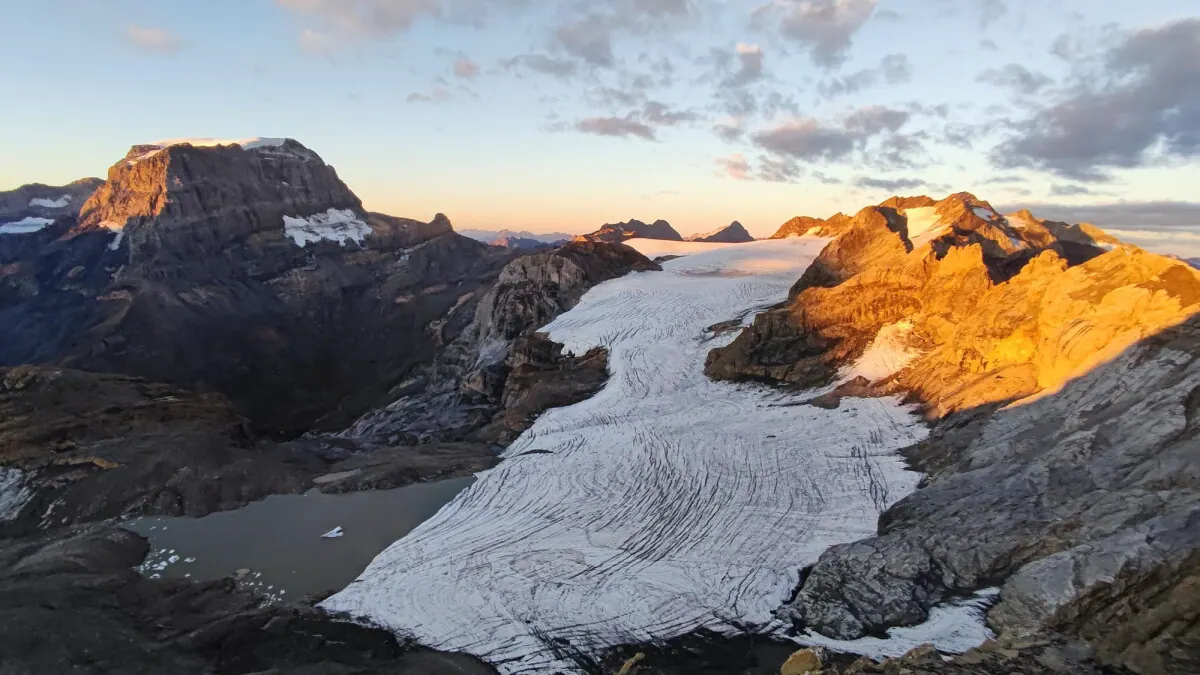
Switzerland's glaciers have suffered another year of significant ice loss, with a 5.5% decline in 2026, according to Matthias Huss, leader of the country's glacier monitoring network, GLAMOS. This decline is part of a wider global trend of glaciers shrinking at increasingly rapid rates, linked to global warming. Huss and his team measure the country's ice fields each summer, documenting rapid ice loss.
The decline in Switzerland's glaciers peaked in 2022, with a record 6% loss in a single year. Huss returned to some of the glaciers at the end of the long, hot summer of 2026 to find much of the ice gone, describing the landscape as "dry and dead" with only remnants of ice blocks melting on the hot rocks. Alpine plants are now seeding themselves in areas once covered by glaciers that were meters thick.
The 2026 glacier monitoring report shows that individual glaciers, including Switzerland's largest, such as the Rhône and Aletsch, have suffered record ice loss this year. These huge ice fields are often referred to as Europe's water towers, storing winter snow and releasing it gently as it melts over the spring and summer. The snowmelt fills Europe's key waterways, like the Rhine and the Danube, crucial for Europe's food supply and more.
The impact of the glacier loss is already being felt, with river levels sinking, freight transport in the Rhine and Danube coming to a standstill, and nuclear power stations having to be temporarily shut down due to lack of cooling water. This situation can only get worse if the melt continues, posing an existential threat to Europe's farmers. The loss of glaciers could lead to drought, and with 1,200 smaller glaciers disappearing in the last 50 years, the trend is alarming.
The instability caused by glacier loss and alpine permafrost thaw also increases the risk of landslides and flooding. Last year, the Swiss village of Blatten was wiped out when a fragile glacier crashed down, bringing the side of the mountain with it and destroying 300 homes. Although the population was evacuated, they are still living in temporary accommodation, with no idea if they will ever be able to return.
Climate change can be a triggering factor for such natural disasters, according to Huss. While mountain environments have always been risky, the disappearance of ice and warming of permafrost can contribute to devastating events, such as the collapse of a glacier on Nepal's border with Tibet, which triggered floods that killed at least 1,400 people.
Huss has little patience for those who still claim climate change does not exist, arguing that the evidence is clear and has been for decades. Without action, Europe's beloved alpine landscape could look very different, with the glacier monitoring unit predicting that all glaciers will be gone by the end of this century if the planet continues to warm at its current rate.
Key points
- Switzerland's glaciers lost 5.5% of their ice in 2026.
- The loss of glaciers poses an existential threat to Europe's farmers and food supply.
- All of Switzerland's glaciers could be gone by the end of this century if global warming continues at its current rate.