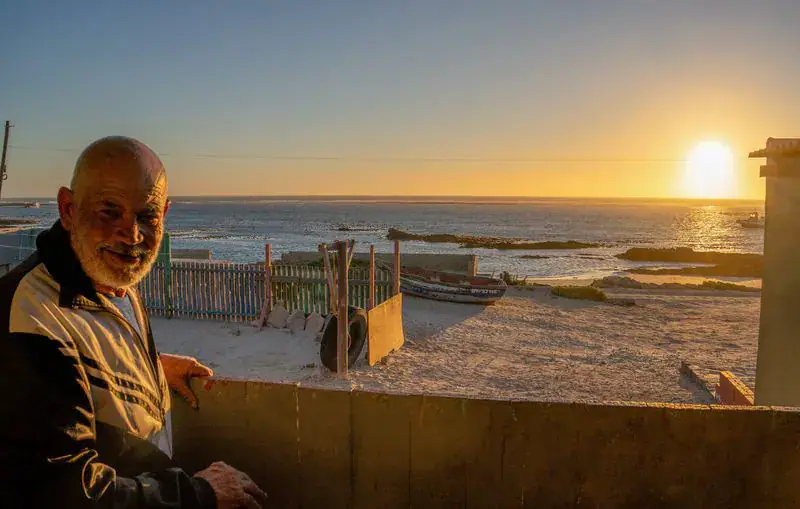
Small-scale fishers along South Africa's West Coast are struggling to adapt to changing weather conditions and unpredictable winds, making it harder for them to plan their livelihoods. Fisherwoman Laurenchia Stevens from Doringbaai has noticed changes in the availability and timing of fish, while others report restricted access to beaches, difficulties securing permits, and rising fuel costs. These overlapping pressures make it harder for fishers to respond to environmental changes and raise questions about what support is available to help them adapt.
The Department of Forestry, Fisheries and the Environment has confirmed that none of South Africa's internationally funded adaptation projects is aimed at small-scale fishing communities on the West Coast. This is concerning, as small-scale fishers face the dire consequences of an ever more uncertain future, and often have no opportunity to mitigate impacts or adapt. According to Alessandro Mazzi, a PhD candidate at Wageningen University & Research, their capacity to adapt should be built, including by promoting alternative livelihoods and economic opportunities.
The issue of adaptation finance was a top priority for South Africa at the 2026 United Nations Climate Change Conference (COP31) in Antalya, Turkey. Environment Minister David Maynier said adaptation would be his top priority at COP31, and that South Africa would push for a benchmark to triple adaptation finance by 2035. However, the summit ended in disarray on Sunday without a deal, leaving open how a promise to triple adaptation finance will be met.
Developing countries had come to Antalya wanting a figure put on last year's promise to at least triple adaptation finance by 2035, but they leave without one, and without any agreed next steps. The first draft of COP31's main decision included a $120-billion figure, but the final draft text dropped the $120-billion floor, deferring decisions on the baseline and how to deliver it to next year's summit.
Fisherwoman Laurenchia Stevens explained that she has to go further out to sea, spending more on petrol but catching less. "As small-scale fisherwomen and men it's very hard for us; when there is no fish, there is no income for our house." Fourth-generation fisher Morgan Johnson said none of his children works in fishing, like many others in his town, because "they don't see the money."
The lack of support for small-scale fishers is particularly concerning, as they are on the frontlines of climate change impacts. According to Alessandro Mazzi, small-scale fishers face the dire consequences of an ever more uncertain future, and often have no opportunity to mitigate impacts or adapt. The Department of Forestry, Fisheries and the Environment needs to prioritize support for these communities.
The outcome of COP31 has left West Coast fishers uncertain about future support. While the summit's failure to agree on tripling adaptation finance is disappointing, it is clear that South Africa and other developing countries will continue to push for greater support for climate adaptation. The fate of small-scale fishers and other vulnerable communities hangs in the balance.
Key points
- Small-scale fishers along South Africa's West Coast are struggling to adapt to changing weather conditions and unpredictable winds.
- The Department of Forestry, Fisheries and the Environment has confirmed that none of South Africa's internationally funded adaptation projects is aimed at small-scale fishing communities on the West Coast.
- The COP31 summit ended without a deal on tripling adaptation finance, leaving open how a promise to triple adaptation finance will be met.